Retinol Room.

Best Retinol Eye Cream Under $25

Four retinoid products for the eye area cost less than $25 — and three of them come in 14 or 15 ml tubes, which makes a $20 eye cream one of the most expensive things per millilitre you will ever buy. Ranked on cost per millilitre and on what the label admits, with live, dated prices.

By Stephen V.Last updated How we pick

The best retinoid for the eye area under $25 is RoC’s Retinol Correxion Under Eye Cream, on experience with the format rather than on a number — RoC has sold retinol for the eye area longer than anyone else in this band, in a 15 ml tube designed to be squeezed rather than dipped into, which is the right packaging for a molecule that degrades in air and light.

Budget pick: Beauty of Joseon’s Revive Eye Serum with Retinal & Niacinamide — the cheapest thing on this page, twice the volume of the tubes it is competing with, and the only product in the band that tells you which molecule you are buying. It is retinaldehyde rather than retinol, which is one oxidation step from retinoic acid instead of two, and the brand states the formula is fragrance-free with no fragrance or parfum anywhere in its published 36-item list. If you are choosing on value, this is the page’s answer and it is not close.

As of November 23, 2026, 4 of the 5 retinoid products for the eye area that we track were listed on Amazon below $25— the live figure from our dated daily check, not an estimate. The band is our label; the price on each button is the truth, so if something has drifted over the line, trust the button.

Which brings us to the arithmetic that organises this page, because the eye-cream shelf is built to keep it out of view. Three of these four products come in 14 or 15 ml tubes. A $20 product in a 15 ml tube costs more per millilitre than almost any face serum we rank, including several that cost twice as much in bottles three times the size. That is not an argument against buying one — it is an argument for knowing that “under $25” and “cheap” are not the same claim here.

Nothing in this band publishes a retinol percentage. Not one of the three American products, from two brands that between them dominate the drugstore eye-care aisle. The Korean retinal does not publish a figure either, but it does publish the molecule and a complete ingredient list, which is more than the rest manage. If you want the eye-area shelf ranked across every price instead of at this ceiling, our eye-cream roundup is that page, and our under-eyes page is blunt about which under-eye problems a retinoid cannot touch at all.

How this is funded: we earn a commission if you buy through our links, at no extra cost to you. It never changes which product we recommend, and we’ll tell you when we’d skip one. Full disclosure.

Quick picks

Ranked on formulation, stated concentration and buyer fit. Select a row to jump to the full write-up. We have not tested these products — here is exactly what we do instead.

#ProductBest forPrice
1
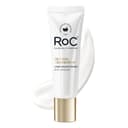
RoC Retinol Correxion Under Eye Cream

RoC Retinol Correxion Under Eye Cream

The reference drugstore retinol eye cream — a retinol formulation made specifically for the thinner skin around the eyes, aimed at crow's-feet and under-eye lines. Widely available and inexpensive, though the strength isn't stated.

Best overall
$19.97 · View on Amazon

$21.979% off

Price as of November 23, 2026. #ad How we’re funded

2
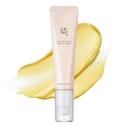
Beauty of Joseon Revive Eye Serum with Retinal & Niacinamide

Beauty of Joseon Revive Eye Serum with Retinal & Niacinamide

The cheapest retinal-containing product we have found anywhere, in a 30 ml bottle sold for the eye area — which in practice means most people use it as a face serum too. Retinal plus niacinamide is a sound pairing: the potent form of vitamin A with the barrier ingredient that makes it tolerable.

Budget pick — best value per millilitre
$11.90 · View on Amazon

$17.0030% off

Price as of November 23, 2026. #ad How we’re funded

3
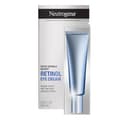
Neutrogena Rapid Wrinkle Repair Retinol Eye Cream

Neutrogena Rapid Wrinkle Repair Retinol Eye Cream

Neutrogena's accelerated-retinol eye cream with hyaluronic acid and glucose complex, targeting fine lines and dark circles. A convenient, well-priced pick — with the usual drugstore caveat of an unstated strength.

Best for dryness around the eye
$17.97 · View on Amazon

$29.4939% off

Price as of November 23, 2026. #ad How we’re funded

4
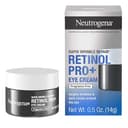
Neutrogena Rapid Wrinkle Repair Pro+ Retinol Eye Cream

Neutrogena Rapid Wrinkle Repair Pro+ Retinol Eye Cream

The 'Pro+' step-up in Neutrogena's eye line, positioned as a higher-potency retinol eye cream for more advanced wrinkles. Useful if the standard version stopped delivering — though, as ever at the drugstore, the actual strength is not disclosed.

Best step-up strength
$23.05 · View on Amazon

Price as of November 23, 2026. #ad How we’re funded

The picks in full

#1Best overall

RoC Retinol Correxion Under Eye Cream

The reference drugstore retinol eye cream — a retinol formulation made specifically for the thinner skin around the eyes, aimed at crow's-feet and under-eye lines. Widely available and inexpensive, though the strength isn't stated.

Strengths

  • Formulated at an eye-appropriate strength for delicate skin
  • Long track record for the eye area specifically
  • Inexpensive and easy to find

Trade-offs

  • Retinol strength not published
  • Contains fragrance — patch-test near the eye first
Key activeRetinol
Stated concentrationNot published
FormatLight eye cream
Fragrance-freeNo
Best forNormal, Mature

Formulation note. Retinol in a formula dosed for the thin skin around the eyes. Eye-area retinol is intentionally milder than face retinol; the exact figure is undisclosed.

Ingredients and claims read from the product listing, on July 18, 2026. “Not published” means the brand does not state that figure.

#2Budget pick — best value per millilitre

Beauty of Joseon Revive Eye Serum with Retinal & Niacinamide

The cheapest retinal-containing product we have found anywhere, in a 30 ml bottle sold for the eye area — which in practice means most people use it as a face serum too. Retinal plus niacinamide is a sound pairing: the potent form of vitamin A with the barrier ingredient that makes it tolerable.

Strengths

  • Retinal paired with niacinamide, which is the buffering combination that actually works
  • 30 ml for eye-area use is a lot of product for the price
  • Light serum texture rather than a heavy eye cream

Trade-offs

  • Retinal concentration is not published
  • Sold for the eye area, so it is dosed conservatively — not a substitute for a face retinoid
Key activeRetinal (retinaldehyde) + niacinamide
Stated concentrationNot published
FormatLight eye serum
Fragrance-freeYes
Best forNormal, Sensitive, Dry

Formulation note. Retinaldehyde with niacinamide in an eye serum. The brand publishes its full 36-ingredient list and states fragrance-free: niacinamide is 7th, the hydrogenated lecithin that forms the retinal liposomes is 13th, ginseng root extract 14th, and retinal itself is 28th. No percentage is stated for either active, so treat it as a gentle introduction to retinal rather than a rung you can place.

Ingredients and claims read from the product listing, on September 26, 2026. “Not published” means the brand does not state that figure.

#3Best for dryness around the eye

Neutrogena Rapid Wrinkle Repair Retinol Eye Cream

Neutrogena's accelerated-retinol eye cream with hyaluronic acid and glucose complex, targeting fine lines and dark circles. A convenient, well-priced pick — with the usual drugstore caveat of an unstated strength.

Strengths

  • Hyaluronic acid + glucose complex for hydration
  • Made specifically for the eye area
  • Inexpensive and widely stocked

Trade-offs

  • Strength not published
  • Fragrance status not published either — the listing is silent and the brand page cannot be read
Key activeRetinol (accelerated retinol SA blend)
Stated concentrationNot published
FormatLight eye cream
Fragrance-freeNot published
Best forNormal, Combination

Formulation note. Neutrogena's retinol SA blend + hyaluronic acid + glucose complex, dosed for the eye area. Hydrating and convenient; the retinol figure is undisclosed. Fragrance status is undisclosed for this one too — the listing makes no claim either way and the brand page cannot be read, which is why the spec table prints 'Not published' where its Pro+ sibling prints 'Yes'.

Ingredients and claims read from the product listing, on November 7, 2026. “Not published” means the brand does not state that figure.

#4Best step-up strength

Neutrogena Rapid Wrinkle Repair Pro+ Retinol Eye Cream

The 'Pro+' step-up in Neutrogena's eye line, positioned as a higher-potency retinol eye cream for more advanced wrinkles. Useful if the standard version stopped delivering — though, as ever at the drugstore, the actual strength is not disclosed.

Strengths

  • Positioned as a higher-potency eye formula
  • Hyaluronic acid for hydration around the eyes
  • Still drugstore-priced

Trade-offs

  • Strength not published — 'Pro+' is branding, not a number
  • Higher potency near the eye means introduce it slowly
Key activeRetinol (Pro+ accelerated retinol)
Stated concentrationNot published
FormatLight eye cream
Fragrance-freeYes
Best forNormal, Mature

Formulation note. Neutrogena's higher-potency 'Pro+' retinol dosed for the eye area, with hyaluronic acid. 'Pro+' denotes a stronger formula than the standard eye cream, but no percentage is published. The listing states 'Formulated without Fragrance, Dyes, Phthalates, and Parabens' (read 2026-11-07), which makes this the fragrance-free one of Neutrogena's two retinol eye creams.

Ingredients and claims read from the product listing, on November 7, 2026. “Not published” means the brand does not state that figure.

The cost-per-millilitre problem

Eye creams are sold in small containers for two reasons, one good and one commercial. The good reason is that you need very little: the orbital area is a small fraction of the face, and the fingertip-unit convention that puts the whole face and neck at about 2.5 units implies a genuinely tiny amount around each eye. A 15 ml tube used correctly lasts months. The commercial reason is that a small container lets a high per-millilitre price hide behind a low shelf price.

Both things are true at once, and the practical consequence is this: do not buy an eye product because it is cheap. Buy it because you want a formula built for thin skin, or a tube rather than a jar, or a size you will finish before the retinoid degrades. On this page the budget pick wins the value argument outright, at roughly twice the volume of the tubes around it for less money — and it wins it by being a serum rather than an eye cream, which is the whole reason the format roundup does not rank it.

Why the degradation point matters more here than anywhere

Small containers are opened often and finished slowly, which is the worst combination for this molecule. A validated study of sixteen retinoid derivatives across twelve commercial cosmetic products found losses of 0% to 80% after six months at 25 °C and 40% to 100% at 40 °C, with light doing more damage than heat, and some products testing below their declared content. The FDA does not require a cosmetic to carry an expiration date and notes that shelf life depends on storage.

So prefer a tube or a pump over a pot, keep it out of a steamy bathroom window, and write the date you opened it on it. A 14 ml tube that takes you a year is not the product you bought by the end of that year. Our guide to whether retinol expires has the detail.

What a retinoid can and cannot do around the eye

This is where most eye-cream pages overclaim, so here is the honest version.

It can help fine lines and crepey texture. That is the mechanism working as advertised: a retinoid changes how fast the surface layer turns over and, over months, the published record on prescription tretinoin shows epidermal hyperplasia and a compacted stratum corneum, with collagen I formation rising by about 80% on ten to twelve months of daily 0.1% tretinoin against a 14% fall on vehicle. No cosmetic retinol inherits those numbers, but the direction of travel is the same and the timescale is the same: roughly ten months of rising improvement before a plateau.

It can help pigment-type dark circles, slowly. The AAD names a retinoid among the ingredients that fade existing dark spots, with a published timeline of six to twelve months for a mark a few shades darker than natural tone. If your circles are genuinely pigment, that is the timescale to expect.

It cannot do anything about structure.Under-eye hollowing, fat herniation and the shadow those cast are anatomy, and no cream reaches them. Nor will a retinoid fix circles that are vascular — visible blue-purple vessels through thin skin — or puffiness driven by fluid and sleep. Our under-eyes page is explicit about the three different things people call dark circles and which one of them is addressable.

And it should not go on your eyelids. The skin there is the thinnest on the body and the margin between the lid and the eye is small. Our page on eyelids covers where the line sits and why a dedicated eye product exists at all.

How we ranked these four

1. Is it formulated and packaged for the eye area? All four are, which is the floor for appearing here. RoC and both Neutrogena tubes are purpose-built eye products; the Beauty of Joseon is sold explicitly as an eye serum.

2. What does the label commit to?None of the four publishes a retinol percentage. One publishes the molecule — retinaldehyde — plus niacinamide and a complete 36-item ingredient list with a fragrance-free claim the brand makes itself. That is why it takes the budget slot rather than being an also-ran.

3. Cost per millilitre, honestly. Two of the three tubes here are 14 ml, one is 15 ml and the eye serum is 30 ml, so the value spread across this page is wider than the price spread by a long way.

4. Fragrance, as published.The RoC eye cream’s published formula carries fragrance; both Neutrogena Pro+ and the Beauty of Joseon serum carry fragrance-free claims; the standard Neutrogena eye cream publishes nothing in either direction, which we record as not published rather than inferring from a sibling product. Around the eye this matters more than elsewhere, because retinoid irritation and a genuine fragrance reaction look similar in the mirror and are different problems. The AAD’s own guidance on reading fragrance-free labels is worth five minutes if your skin reacts to things.

What is not in the band

RoC’s Derm Correxion Retinol Eye Repair Cream — the one with niacinamide alongside the retinol, and the pick we would normally reach for on tone — sits above $25 on our latest check, which is why it is on the format roundup and not here. Nothing else in our registry is an eye product. We do not invent entries to fill a slot, and we do not rank a face serum as an eye cream: if you would rather use a careful face product around the orbital bone than buy a dedicated one, that is a legitimate choice, but read the eyelid page first and start at the bottom of the percentage ladder regardless of what your face tolerates.

How to start around the eye

Less product, less often, and further out than feels natural. A rice-grain amount per eye, patted along the orbital bone rather than rubbed toward the lash line, two nights a week for the first month. Moisturizer over the top. Sunscreen every morning without exception, and be aware that eye-area sunscreen application is the step most people skip entirely.

If it stings, water the dose down rather than stopping: a plain moisturizer first, the retinoid over it, as our sandwich-method guide describes. If your skin is already red or flaking, stop and read what to do about retinol burn before you buy anything else. And if you have reacted to a retinoid anywhere on your face before, our gentle roundup ranks the options by the mechanism that makes each one gentle rather than by who the box says it is for.
Frequently asked questions

What is the best retinol eye cream under $25?

RoC's Retinol Correxion Under Eye Cream, on experience with the format rather than on a published figure — it is the longest-standing retinol eye product in the band, in a 15 ml tube rather than a pot. If you are choosing on value instead, the Beauty of Joseon retinal eye serum is roughly twice the volume for less money and is the only product in the band that tells you which molecule it contains.

Do any retinol eye creams under $25 publish their strength?

No, not one. The three American products come from two brands that publish no retinol percentage for any product they sell, and the Korean retinal serum publishes its molecule and a complete ingredient list but no figure either. If a published dose is what you want around the eye, the honest answer is that it does not exist at this price — which is one reason to start at the bottom of the ladder and go slowly.

Is a $20 eye cream good value?

Rarely, once you do the arithmetic. Three of the four products here come in 14 or 15 ml containers, so a $20 shelf price is a higher cost per millilitre than most face serums we rank — including several that cost twice as much in bottles three times the size. The counterargument is that you need very little around the eye, so a small tube genuinely lasts months. Buy small deliberately, not because it looked cheap.

Will a retinol eye cream get rid of my dark circles?

Only if they are pigment, and only slowly. The AAD names a retinoid among the ingredients that fade existing dark spots, with a published timeline of six to twelve months for a mark a few shades darker than natural tone. Circles caused by visible vessels through thin skin, by hollowing beneath the eye, or by fluid and sleep are not pigment and no cream reaches them. Our under-eyes page separates the three.

Can I use a regular retinol serum around my eyes instead?

Carefully, and not on the eyelids. The skin there is the thinnest on the body, which is why dedicated eye products exist and why our eyelid guide is worth reading first. If you do use a face product, use a rice-grain amount patted along the orbital bone rather than toward the lash line, start at the bottom of the strength ladder regardless of what the rest of your face tolerates, and go twice a week for the first month.

Why does the eye serum beat the eye creams on value?

Volume. It is a 30 ml serum competing with 14 and 15 ml tubes at a lower shelf price, so it wins on cost per millilitre by a wide margin. It also publishes more: the molecule is retinaldehyde rather than unnamed retinol, niacinamide is declared alongside it, and the brand publishes a complete 36-item ingredient list with its own fragrance-free claim. It is not an eye cream, which is exactly why our format roundup does not rank it.

How often should I use a retinol eye cream?

Two nights a week for the first month, then three if your skin is comfortable. Around the eye, less and slower beats more and faster by a wider margin than on the rest of the face, because the skin is thinner and irritation there is more visible and more uncomfortable. Moisturizer over the top, and sunscreen every morning — eye-area sunscreen is the step almost everyone skips.

Is a tube better than a pot for an eye cream?

For a retinoid, yes. A validated study across twelve commercial cosmetic products measured retinoid losses of 0% to 80% after six months at 25 °C and 40% to 100% at 40 °C, with light doing more damage than heat. A pot opened nightly exposes the formula to far more air and light than a tube. All four picks here are tubes or pump bottles, which is deliberate rather than coincidental.

Sources

  • American Academy of Dermatology — Retinoid or retinol? — AAD on the difference between prescription retinoids and OTC retinol (accessed July 17, 2026)
  • U.S. FDA — 21 CFR 701.3, Designation of ingredients (eCFR) — The federal rule governing how a cosmetic ingredient list is ordered. Paragraph (a): 'The label on each package of a cosmetic shall bear a declaration of the name of each ingredient in descending order of predominance, except that fragrance or flavor may be listed as fragrance or flavor.' Paragraph (f) allows an alternative: ingredients 'present at a concentration greater than 1 percent, in descending order of predominance', followed by ingredients 'present at a concentration of not more than 1 percent, without respect to order of predominance', followed by color additives 'without respect to order of predominance'. Cited for the exact limit of what an ingredient's POSITION can tell a reader: late placement indicates the 1-percent-or-less group, but within that group the order carries no information about quantity (accessed September 26, 2026)
  • Tolerance profile of retinol, retinaldehyde and retinoic acid under maximized and long-term clinical conditions (PubMed) — Retinol and retinaldehyde share a low irritation potential; retinoic acid (tretinoin) is more irritating (accessed July 17, 2026)
  • Human Skin Aging and the Anti-Aging Properties of Retinol (PubMed) — Review of topical retinol's effect on collagen and photoaging (accessed July 17, 2026)
  • The use of retinoids in the treatment of photoaging (PubMed) — Clinical-trial evidence for topical retinoids in photoaging (accessed July 17, 2026)
  • American Academy of Dermatology — How to fade dark spots in darker skin tones — AAD names a retinoid (retinol, tretinoin, adapalene gel or tazarotene) among the ingredients that can fade existing dark spots; advises stopping any product that burns or stings and choosing one labeled fragrance-free or for sensitive skin; recommends a tinted sunscreen containing iron oxide at SPF 30 or higher; and puts the timeline at 6 to 12 months for a spot a few shades darker than your natural skin color, with deeper discoloration taking years (accessed August 27, 2026)
  • Beauty of Joseon — Revive Eye Serum: Ginseng + Retinal (brand product page) — The brand's own page for the product Amazon lists as 'Revive Eye Serum with Retinal Niacinamide'. Publishes the full 36-ingredient INCI, in which niacinamide is 7th, hydrogenated lecithin (the liposome carrier the brand names) 13th, panax ginseng root extract 14th and RETINAL 28th, with ceramide NP and palmitoyl tripeptide-5 last. States 'Fragrance-Free'; directions are 'Pump the applicator 1-2 times and use your ring finger to gently pat the product under the eyes and around the eye area. Use morning and night, and always layer under sunscreen during the day', plus 'If you have sensitive skin, we recommend a 24-hour patch test before use'. Its efficacy claim is 'Clinically tested to improve the appearance of wrinkles by 8.65% in two weeks', footnoted 'According to a study conducted by Korea Dermatology Research Institute on 21 subjects over two weeks' — a small, unpublished, brand-commissioned study. The brand's ingredient explainer states 'the highly-sensitive retinal is enclosed in a special carrier called a liposome' of hydrogenated lecithin. NO retinal or niacinamide percentage is stated anywhere on the brand's site. Cited for what the brand publishes about its own formula, never as evidence of efficacy (accessed September 26, 2026)
  • Neutrogena Rapid Wrinkle Repair Retinol Eye Cream — Amazon listing (Creators API record) — The listing record for ASIN B004D24818, re-pulled through the Amazon Creators API on November 7, 2026: title "Neutrogena Rapid Wrinkle Repair Retinol Eye Cream, 0.5 fl. oz | For Dark Circles, Anti-Aging Under Eye Cream, Retinol & Hyaluronic Acid, Fine Lines Wrinkles & Dark Spots", availability "In Stock", live price returned. Cited for what the listing DOES state — retinol plus hyaluronic acid, 0.5 fl oz, dark circles and fine lines as the target — and, as importantly, for what it does NOT: no retinol percentage, and no fragrance claim in either direction. Neutrogena's own product page returns 403 to a direct fetch, so this site records the fragrance status of this particular eye cream as "Not published" rather than asserting either way, and the earlier registry value of "contains fragrance" was removed as an unsourced affirmative claim (accessed November 7, 2026)
  • Neutrogena Rapid Wrinkle Repair Retinol Pro+ Anti-Wrinkle Eye Cream — Amazon listing (Creators API record) — The listing record for ASIN B0B2TH7C4H, re-pulled through the Amazon Creators API on November 7, 2026. Title, verbatim: "Neutrogena Rapid Wrinkle Repair Retinol Pro+ Anti-Wrinkle Eye Cream, 0.5 oz | Targeted Eye Cream for Wrinkles & Dark Circles, Formulated without Fragrance, Dyes, Phthalates, and Parabens". Cited as the evidence that this product IS fragrance-free — the claim is in the listing title itself, and Neutrogena's own product URL for it ends `...-retinol-pro-eye-cream-fragrance-free/`. It corrects a registry value that had recorded the opposite since the 2026-07-18 launch batch with no provenance. The listing returned a live price but an EMPTY availability string on that date, which is why this site does not make it a headline pick. It states no retinol percentage: "Pro+" is branding, not a number (accessed November 7, 2026)
  • Long CC, Finlay AY — The finger-tip unit: a new practical measure (Clin Exp Dermatol, 1991) — The paper that defined the fingertip unit. Thirty adult patients treated various body regions; the number of FTUs required was face and neck 2.5, front of trunk 6.7, back of trunk 6.8, arm and forearm 3.3, hand 1.2, leg and thigh 5.8, foot 1.8. One FTU covers 286 cm2 (s.d. 80) — 312 cm2 in males, 257 cm2 in females. It is a dermatological DOSING measure for ointments, not a retinol instruction, and is cited here only as the published way to reason about how much topical product an area takes (accessed September 18, 2026)
  • Temova Rakuša Ž, Škufca P, Kristl A, Roškar R — Retinoid stability and degradation kinetics in commercial cosmetic products (J Cosmet Dermatol, 2021) — Validated HPLC-UV study of 16 retinoid derivatives (retinol, retinyl palmitate, beta-carotene and hydroxypinacolone retinoate) in 12 commercial cosmetics over 6 months of long-term and accelerated stability testing plus a one-week photostability study. Retinoid degradation followed first-order kinetics; the products showed a 0%-80% decline after 6 months at 25 °C and a 40%-100% decline at 40 °C; 'light degradation was more pronounced than temperature-induced degradation'; instabilities were 'formulation-dependent and associated with lower contents than declared in some cosmetics'. Cited for the size of the stability problem a sealed single-dose format is built to solve — the study did not test this product (accessed September 19, 2026)
  • Griffiths CE et al. — Restoration of collagen formation in photodamaged human skin by tretinoin (N Engl J Med, 1993) — Biopsies from 26 subjects plus 29 patients treated 10 to 12 months with daily 0.1% tretinoin cream (15 patients) or vehicle (14). Collagen I formation was 56% LOWER in photodamaged skin than in sun-protected buttock skin (P < 0.001); tretinoin produced an 80% INCREASE in collagen I formation against a 14% decrease on vehicle (P = 0.006). Prescription tretinoin, not cosmetic retinol — cited for the direction of the effect on dermal collagen (accessed September 18, 2026)
  • Voorhees JJ — Clinical effects of long-term therapy with topical tretinoin and cellular mode of action (J Int Med Res, 1990) — Double-blind, placebo-controlled study: 0.1% topical tretinoin reduced the effects of photoageing maximally after 10 months, with no further improvement between 10 and 22 months. Histologically it induced 'epidermal hyperplasia, compaction of the stratum corneum and the deposition of ultrastructurally visible collagen fibrils in the papillary dermis', reduced the number and activity of melanocytes, and significantly increased mitoses (accessed September 18, 2026)
  • U.S. FDA — Shelf Life and Expiration Dating of Cosmetics — FDA states no U.S. law requires cosmetics to carry an expiration date, that drugs (including sunscreens and acne treatments) must, and that heat and dipping fingers into a product shorten its usable life (accessed August 19, 2026)
  • American Academy of Dermatology — How can I find eczema friendly products? — AAD sets out the difference between the labels: unscented means a fragrance is masked so you cannot smell it, fragrance-free means the product contains no fragrance at all (accessed August 19, 2026)

Keep reading