What a sealed capsule actually fixes
This is the rare format claim with a measured problem behind it. A validated HPLC study of 16 retinoid derivatives across 12 commercial cosmetics tracked them through six months of stability testing and a one-week photostability study. The findings are worth stating in full, because they are the entire argument for buying capsules at all:
- Retinoid content declined by anywhere from 0% to 80%after six months at 25 °C — room temperature.
- At 40 °C, the decline was 40% to 100%.
- “Light degradation was more pronounced than temperature-induced degradation.”
- The instabilities were formulation-dependent and were associated with lower contents than declared in some of the products.
So the thing a capsule removes is real: a part-used bottle sits in a warm, lit bathroom for months with air in the headspace, and the active in it is on a first-order decay curve the whole time. A sealed single dose never experiences any of that. Both of these products deliver that benefit identically, and neither brand had to invent it.
Two honest limits. The study did not test either of these products, so this is the size of the problem rather than a measurement of these solutions. And a capsule does nothing about degradation before it reaches you — it protects the product in your bathroom, not in a warehouse. Our guide to retinol shelf life works through the full packaging hierarchy, and single-dose capsules sit at the top of it.
The second thing it fixes, which nobody advertises
A capsule is a pre-measured dose. The most common beginner error is not choosing the wrong strength — it is using three or four times too much of the right one, which buys you flaking and no extra benefit. A capsule makes that mistake physically impossible. For a first retinoid that is arguably worth more than the stability argument. Our guide to how much retinol to use has the published dosing measure and what a bottle should actually last.
The two formulas, as published
RoC: eight ingredients, printed
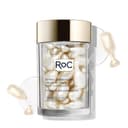
RoC’s own product page lists the whole formula: cyclopentasiloxane, ethylhexyl cocoate, dimethiconol, soybean oil, retinol, dimethylmethoxy chromanol, ceramide NP and phenoxyethanol. That is a silicone-and-oil base, the retinol, an antioxidant, one ceramide and a preservative. The page states “formulated without fragrance” and that each capsule is vegetal-based and biodegradable.
An eight-item anhydrous list is a genuinely informative disclosure. There is no water in it, which is consistent with a retinoid stability strategy rather than a marketing one, and there is nowhere for an undeclared irritant to hide. It is the only fragrance-free product in RoC’s retinol range.
What the page does notcontain is a retinol percentage, anywhere. It also carries efficacy claims — 97% visibly smoother skin in one night, 100% visibly firmer in four weeks, 0% irritation among testers — with no sample size, no study design and no publication, and the Amazon listing quotes the same study with different figures. Treat those as advertising. Our full review takes them apart line by line.
Elizabeth Arden: more actives, fewer figures
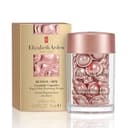
Elizabeth Arden pairs retinol with HPR — hydroxypinacolone retinoate, a retinoid ester — plus ceramides. On paper that is the more sophisticated formula: two retinoids working at different points, with barrier lipids in the same capsule.
The problem is that neither concentration is published. The one clinical study we can cite on an HPR-plus-retinol combination used 0.1% HPR with 1% encapsulated retinol and reported a 41% mean reduction in acne grade in an open pilotwhose own authors called for a controlled trial. Elizabeth Arden does not state that it uses those figures, so that study tells you the combination has been studied somewhere — not what is in this capsule. Our full review of the Elizabeth Arden capsules goes through the formula and the two figures the brand does not print, and our retinol vs Granactive Retinoid comparison covers what retinoid esters do and do not do.
One word, two different things
Both products get called “encapsulated retinol” and neither is, in the sense that term usually means. These are physically encapsulated single doses— a sealed capsule per night. Molecular encapsulation, where the retinol molecule itself is carried in a delivery vehicle inside a normal bottle, is a different technology aimed at release rate as well as stability. Both approaches address stability; they are not the same thing. The Versed serum in the table above is the molecular kind, in a bottle, and our encapsulated retinol roundup separates the two properly.
Cost per night, which is the real comparison
Both boxes are 30 capsules, so the arithmetic is unusually clean: divide the live price in the table above by 30 and you have the cost of a night. At the prices showing here, RoC lands well under a dollar a night and Elizabeth Arden lands close to two. Over a year of four-nights-a-week use that is a difference of real money for a benefit neither brand quantifies.
The running-cost objection applies to both, and it is the honest weakness of the whole format: 30 capsules is a month at nightly use, where a 30 ml bottle at a pea per night lasts far longer. You are paying a premium for packaging. Whether that is worth it depends entirely on whether the stability and dosing problems above are ones you actually have — and if you keep your retinol in a cool dark drawer and already measure a pea, they may not be.
Which one for which buyer
A first-ever retinoid
RoC, and start every other night rather than nightly — which is RoC’s own published direction, and it is correct. The pre-measured dose removes the most common beginner error, the fragrance-free eight-item formula removes the most common irritant, and the price makes an unsuccessful experiment cheap. The beginner roundup has the wider set.
Dry or reactive skin
Either, with a small edge to Elizabeth Arden on formulation reasoning: ceramides plus an ester alongside the retinol is deliberate buffering. RoC’s formula also contains ceramide NP and is the one confirmed fragrance-free, which pulls the other way. If barrier support is the priority rather than the format, our retinol with ceramides roundup is the better starting page.
Someone who wants to know what they are applying
Neither, strictly. Both strengths are unpublished, and no capsule will tell you a number. If the figure matters more than the format, buy a product that prints one and keep it in a drawer — The Ordinary’s 0.5% is in the table above for exactly that reason, and our percentages guide explains what the number buys you.
A gift
Elizabeth Arden, on presentation rather than on formula, and that is a fair reason to buy it. A premium boxed capsule serum gives better than a drugstore carton. Our retinol gift guide handles the rest of that question.
The verdict
RoC, for most people, most of the time. The sealed format is the entire value proposition of both products, both deliver it equally, and only one of them also publishes its formula and charges drugstore money. Elizabeth Arden’s extra actives are real and may well suit drier skin better — but you are paying a premium for ingredients whose quantities neither you nor we can read, and the cheaper product is the one being more straightforward with you.