What counts as pure retinol
Skin only responds to retinoic acid. Everything sold over the counter is a precursor that has to be converted inside the skin, and the number of conversion steps is the one thing that genuinely separates these molecules. A retinyl ester has to be hydrolyzed to retinol first, then oxidized twice. Retinol is oxidized twice. Retinal is oxidized once. Adapalene skips the chain altogether because it is already an active drug, which is why it is regulated as one.
“Pure retinol” means the retinoid in the bottle is retinol, with no ester and no retinoate standing in for it. That is worth knowing, because more steps generally means less of the active arriving, and because the published human record for cosmetic retinol is built on retinol rather than on its derivatives. The American Academy of Dermatology’s own explainer on the difference between prescription retinoids and over-the-counter retinol is the right starting point if the whole category still reads as one word.
What the phrase cannot do is quantify. Nothing requires a cosmetic brand to state a concentration, and the federal rule that orders ingredient lists stops being useful exactly where this question starts: ingredients above one percent are declared in descending order of predominance, and everything at one percent or less may be listed without respect to order of predominance. Every cosmetic retinoid sits in that second group. So a label can say “pure retinol”, list it accurately, and still be anywhere from a token dusting to a serious dose. Position proves presence. Only a published figure proves amount.
The three labels that say it, and the one number
These are worth putting side by side, because the pattern runs opposite to what price would predict.
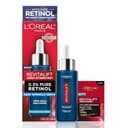
L’Oreal Paris Revitalift 0.3% Pure Retinol Night Serumputs both halves on the bottle: the molecule and the dose. It is a drugstore serum, and it is the only product on this page whose own product name tells you everything you need to place it on a ladder. We reward that, and we name the trade honestly — it contains fragrance, which is a real consideration for reactive skin and which every other fragrance-free pick here avoids.
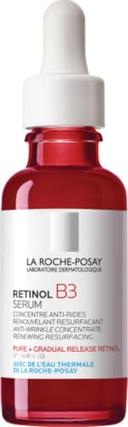
La Roche-Posay Pure Retinol Face Serum (B3 + HA)has the phrase in its actual product name and publishes no percentage at all. The formula around it is genuinely good — retinol with niacinamide, glycerin and hyaluronic acid, so the buffering is inside the bottle rather than something you layer yourself, fragrance-free, from a brand built around reactive skin. You are paying for the formula and the dermatology distribution record, not for information. It is the most expensive unstated dose on this page.
Neutrogena Rapid Wrinkle Repair Retinol Pro+ Power Facial Serumstates pure retinol and nourishing emollients in its listing title, and no figure. “Pro+” is a tier name inside Neutrogena’s own range, not a dose, and this listing makes no fragrance claim in either direction while two other products in the same line do. Credit where it is due: specifying pure retinol rather than an ester is more than most drugstore listings bother with. Our Neutrogena range roundupranks all five of the brand’s retinols and goes through that fragrance inconsistency in detail.
How we ranked these
Four criteria, in this order.
1. Can you read the dose?Four of the seven publish an exact figure — 0.1%, 0.3%, 0.5% and 1%. That is unusually high for this shelf, and it is not a coincidence: it is the filter. A stated dose is the only thing that makes escalation a decision rather than a guess. If a product is doing nothing after six months, a number tells you whether to go up a rung or change format; without one you are starting over.
2. Is there a rung above and below it? A single stated strength sold alone is less useful than the same strength sold inside a range. The Ordinary sells 0.2%, 0.5% and 1%; COSRX sells 0.1% with a 0.3% above it. Both are ladders you can climb without changing the base your skin has already proved it tolerates, which removes the variable people most often change by accident.
3. What is carrying it?Pure retinol dries and flakes skin while it works. A base with niacinamide, ceramides or glycerin in it softens that landing; a base of squalane and nothing else does not, and leaves the cushioning to your moisturizer. Both are legitimate — one is a formula decision, the other a routine decision — but you should know which you are buying.
4. Does it say anything about fragrance?We report what the brand publishes and nothing more. Five of these seven are fragrance-free on the published label, one states fragrance outright, and one says nothing in either direction, which we record as not published rather than inferring from a sibling product. Retinoid irritation and an actual fragrance allergy look similar in the mirror and are different problems; the AAD’s own guidance on reading “fragrance-free” and on what causes contact dermatitis is worth five minutes if your skin reacts to things.
We rank nothing on a claim we cannot check. Nobody here has tested these products on skin, we run no trials, and a page that tells you how a retinol “felt” after four weeks of in-house use is telling you a story. What we can do is read every label and every published ingredient list carefully, and say plainly where the information stops.
What is not on this page, and why
This filter excludes a lot of good products. That is the point of having it.
Granactive retinoid, also called hydroxypinacolone retinoate.A synthetic ester of 9-cis-retinoic acid, not retinol. Its own evidence is a single open pilot study of a fixed combination containing 0.1% HPR plus 1% encapsulated retinol — a 41% mean reduction in acne grade, mild-to-moderate local side effects in 15.3% of users, and the authors themselves calling for a controlled trial. It is a reasonable thing to buy if retinol has repeatedly been too much for you. It is not retinol. Our comparison of the two is the detail.
Every retinal.Retinaldehyde is one oxidation step from retinoic acid where retinol is two, and the published tolerance work groups it with retinol rather than with tretinoin — so it is a genuinely interesting molecule, and unusually, most brands selling it will print the number. It has its own roundup here, and the head-to-head is the page if you are choosing between the two.
Retinol-plus-retinal hybrids.Two products we rate — SKIN1004’s 0.2% ampoule and PURITO’s serum — carry both molecules. The SKIN1004 publishes its retinol figure and not its retinal one, which makes it impossible to place cleanly on either ladder, and PURITO publishes neither. Good formulas, wrong page.
Products where retinol shares the label with an ester.Olay’s Retinol 24 MAX serum combines retinol with retinyl propionate and niacinamide, so the retinoid is a blend rather than retinol alone. Separately, Olay’s own Retinol24 collection page names the active “Pro-Retinol”, publishes no definition of what that blend contains and no concentration for any product in the line; its single figure is a relative one, “Pro Retinol 19% more”, footnoted against another Olay product. A comparison to an unpublished baseline is not a dose.
Adapalene. A third-generation retinoid and an actual drug, sold over the counter at 0.1% for acne. Different molecule, different regulatory category, different page.
Fermented and complexed retinols.Beauty of Joseon’s moisturizer is the instructive case. The brand states it is built on “1.0% fermented retinol” and, to its considerable credit, also states that this “contains 0.01% (100 ppm) pure retinol”. Both numbers are true and they are a hundredfold apart. Read a complex percentage as a complex percentage.
Which rung to start on
If you have never used a retinoid, start at the bottom and give it longer than feels necessary. COSRX’s stated 0.1% is about as low as a labeled retinol goes and is sold with a 0.3% directly above it, which makes it the cleanest first rung here. Two or three nights a week for a month, then reassess.
A stated 0.5% is the sensible middle for most people who have used a retinoid before and want it to be doing something. A stated 1% is the top of the over-the-counter ladder and is for skin already comfortable nightly — our high-strength roundup covers when that step is worth taking, and our guide to increasing strength covers how to know.
One published study speaks directly to doing this in sequence rather than in one jump. A twelve-week double-blind comparison in 45 photoaged women escalated a retinol serum through 0.25%, 0.5% and 1.0% against tretinoin cream escalated through 0.025%, 0.05% and 0.1%, each with a moisturizer. The two finished at parity on investigator and subject assessment and on water loss through the skin; the retinol arm improved visual smoothness faster at week four and dryness significantly, and week-twelve biopsies showed newly formed collagen with greater epidermal thickening in the retinol group. It is cosmetic-industry-adjacent research rather than an independent trial, and we cite it for the escalation method and the direction of the histology, not as proof that retinol equals tretinoin.
What pure retinol can and cannot do
The record this whole category leans on is prescription tretinoin, not retinol, and the honest version of it is both more impressive and more limited than the marketing. In photodamaged skin, collagen I formation is substantially lower than in protected skin; on ten to twelve months of daily 0.1% tretinoin it rose by about 80% against a 14% fall on vehicle. The histology shows epidermal hyperplasia and a compacted stratum corneum. The curve rises for roughly ten months and then plateaus.
No cosmetic retinol inherits those numbers, at any price. What they do share is a mechanism and a timescale, which has two practical consequences. The first is that judging a retinol at six weeks is judging it too early. The second is that stoppingis the real failure mode — a product you use for ten months is worth more than a stronger one you abandon in six weeks, which is the whole argument of our value roundup. And retinol will not tighten skin that has genuinely lost its structure; our page on sagging is blunt about where that line sits.
Storage matters more for this molecule than for most
Retinol degrades, and the degradation is measured rather than theoretical. A validated study of sixteen retinoid derivatives across twelve commercial cosmetic products found losses of 0% to 80% after six months at 25 °C and 40% to 100% at 40 °C, with light doing more damage than heat, and some products testing below their declared content. The FDA, for its part, does not require a cosmetic to carry an expiration date at all, and notes that shelf life depends on how the product is stored.
Three things follow. Buy a size you will finish — a stated 1% in a bottle that lasts you eighteen months is not a stated 1% by the end of it. Prefer opaque packaging and a narrow neck over a wide open jar. And keep it out of a steamy bathroom window. Our guide to whether retinol expires has the detail, including why anhydrous squalane formulas have fewer problems here than water-based ones.
How to start without losing a fortnight to peeling
At night, on dry skin, two or three nights a week, moisturizer over the top, sunscreen every morning without exception. Hold that for four weeks before you change anything, and change one thing at a time. If you are coming off another retinoid, match the frequency you were already using rather than the strength on the label — in at least three of these cases you are moving between unknowns.
The specific mistake this page can help you avoid is stacking an unstated dose on top of an unstated dose. If you use a retinol night cream and add a “pure retinol” serum, and neither publishes a figure, you have no idea what you are now applying. Pick one. Our routine guide has the order of operations, our mistakes guide covers the errors that cost people months, and our beginner guide is the gentler version of everything above.