Why elbows and knees behave differently from the rest of you
Three things set this skin apart. It sits over a joint, so it is repeatedly folded and stretched. It takes direct mechanical load — a desk, a floor, a car door — in a way that cheeks never do. And it has fewer sebaceous glands than the face or the chest, so it runs drier with less help, which is why the AAD’s dry-skin guidance about moisturizing damp skin and reaching for a cream rather than a thin lotion matters more here than almost anywhere.
Thickened skin in response to repeated pressure is a normal protective adaptation. It is not damage, and nothing on this page will stop your body making it where the pressure continues. What a retinoid can do is keep that layer from becoming as thick and as uneven as it otherwise would, and help the pigment trapped inside it clear faster than it would on its own.
Dry and rough, or genuinely discolored?
Worth sorting out, because the answer changes what to buy. Put a plain moisturizer on for a week. If the area looks noticeably better and feels smooth, the brown was mostly dryness and shadow in rough texture, and a good moisturizer used consistently may be the whole answer — no retinoid required. If it feels smoother and still reads darker than the skin above and below it, there is pigment in there, and that is the case where a retinoid earns its place over a longer run.
One exclusion: if the darkening is velvety rather than rough, appeared relatively quickly, or sits in body folds such as the neck and armpits as well, that is a pattern worth having a clinician look at rather than treating with a cosmetic. Changes in skin pigmentation can have medical causes, and the AAD’s standing advice on any new or changing patch of discoloration is to get it checked before you start treating it.
The dose arithmetic, which is the part people get wrong
A face takes a pea. Elbows and knees do not, and the published fingertip-unit measure is the only honest way to reason about it: face and neck together need 2.5 fingertip units, an arm and forearm 3.3, and a leg and thigh 5.8, where one unit covers about 286 cm². That is a dermatological dosing scale for ointments rather than a retinol instruction, but it makes the shape of the problem clear — the limbs take several times what a face takes, and a 30 ml face serum used on them runs out in a fortnight.
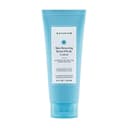
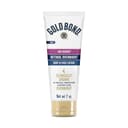
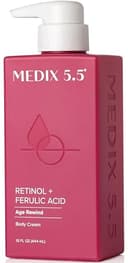
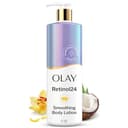
Two practical consequences. If you are treating the joints only, you are treating a small area and a smaller tube can make sense — including the one pick here that prints an actual strength. If you are treating elbows, knees, shins and the backs of the arms, buy by the ounce: cost per ounce is the figure that decides whether you will still be doing this in six months. Our body lotion roundup ranks the whole category on exactly that.
The routine, in four lines
- Shower, then moisturize damp skin.The AAD’s dry-skin guidance is to apply within minutes of patting dry, which matters more on limbs than on a face.
- Retinol lotion at night, two or three nights a week to start. Elbow and knee skin tolerates more than facial skin, but there is no prize for finding the limit in week one.
- A plain thick cream on the other nights.This is not optional on joints — the cream is doing half the work, and the retinoid is doing the half that takes months.
- Reduce the friction you control. A sleeve or a mat where you lean or kneel does more for a stubborn elbow than stepping up a strength.
Sunscreen is a smaller factor here than on a face, but not zero: if the area is uncovered outdoors, pigment you are trying to clear is being topped up. The same logic as our sunscreen guide, scaled down.
What this page is not
Not keratosis pilaris. The small rough bumps on the backs of the upper arms and thighs are a different condition with different treatment, and the AAD names specific acids and retinoids for it. That lives on our keratosis pilaris page.
Not crepey skin. Thin, finely wrinkled skin on the arms is a loss of dermal support, which is the opposite problem from a thickened surface layer. See retinol for crepey skin.
Not a bleaching page. Nothing here is ranked on lightening skin as a goal. The aim is evening out discoloration that is darker than your own tone in that spot, on the timeline the AAD publishes, which is a different thing and a slower one. If an even tone across a joint by next month is the requirement, no cosmetic on this site will deliver it.
What we left out, and why
Face serums.A stated 1% face retinol will work on an elbow and will cost a fortune doing it — 30 ml does not cover limbs for long. The exception is the one small-tube pick above, which exists precisely because joints alone are a small area.
Scrubs and pumice. Mechanical abrasion on skin that has thickened because of friction is the one intervention whose mechanism argues against itself. Gentle exfoliation has a place; sanding an elbow does not.
Products whose retinol we could not verify, and the jumbo 14 oz size of the Naturium lotion— a real option if you like the product and are treating a lot of surface area, worked through in our full review rather than ranked twice here.