The fragrance split, and why we rank on it
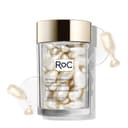
Three of RoC’s four retinols contain fragrance. The capsules do not: the brand’s own product page states “FORMULATED WITHOUT FRAGRANCE” and publishes the entire ingredient list — cyclopentasiloxane, ethylhexyl cocoate, dimethiconol, soybean oil, retinol, dimethylmethoxy chromanol, ceramide NP, phenoxyethanol. Eight items. No water, no fragrance, a ceramide and an antioxidant. For a drugstore product that is remarkable transparency, and we weight it accordingly.
The reason this is not fussiness: fragrance is among the commonest causes of allergic contact dermatitis, and that reaction is frequently delayed— it shows up hours or days after exposure. Which means it lands squarely in the window where a new retinoid user expects some adjustment, assumes the stinging and redness is the retinol, and quits. The retinoid record plateaus at roughly ten months of continuous use, so quitting in week three is the main way a retinol fails. If your skin is reactive, the fragrance-free capsules are not a nice-to-have on this shelf; they are the product.
What the capsule format actually buys
Two things, and one of them is measured. The measured one is stability: a validated study of sixteen retinoid derivatives across twelve commercial cosmetics found degradation of 0% to 80% after six months at 25 °C and 40% to 100% at 40 °C, with light degradation more pronounced than heat, and noted instabilities “associated with lower contents than declared in some cosmetics”. A sealed single dose is a direct structural answer to that — the product is not sitting half-used in a warm bathroom oxidising between applications. The study did not test this product, and we are not claiming it did.
The second thing is dose control. A pre-measured capsule removes the commonest beginner error, which is using far too much. The trade-off is running cost: thirty capsules is a month at most, where a 30 ml cream lasts longer. Our full review of the capsulesworks through the arithmetic, and also takes apart the brand’s “97% had visibly smoother skin in 1 night” claim — a figure quoted with no sample size, no design and no publication, and quoted differently on the Amazon listing than on RoC’s own page.
The two eye creams, which are not the same product
The classic Retinol Correxion Under Eye Cream is retinol dosed for thin eye-area skin, 15 ml, and the cheapest route into this range. The newer Derm Correxion Retinol Eye Repair Creampairs retinol with niacinamide at about half again the price, which is a reasonable addition for the eye area because niacinamide has its own published record on tone rather than only on texture. Choose on what is bothering you: lines and crow’s feet, take the cheap one; discoloration as well as lines, the niacinamide one earns its premium. Our eye cream roundupputs both against Neutrogena’s two, and our under-eye concern page is honest about which under-eye problems a topical cannot reach at all.
The criteria, in order
- Published fragrance status, weighted heavily, for the delayed-reaction reason above. One of four passes.
- How much of the formula the brand will show you. With no percentage available from anyone in this category, a complete published ingredient list is the next best thing, and only the capsules have one.
- Format fit. A cream for dry skin, a serum for normal, an eye-dosed product for the eye area. None of these is better in the abstract.
- Cost of a ten-month run, not cost of a pack — which is where the capsules lose ground and the cream wins it back.
- Claims we can check. An efficacy claim with no sample size and no publication earns a product nothing here, however often it is printed.
Which one, by situation
Reactive, sensitive or fragrance-avoiding skin: the capsules, and nothing else in this range. If the running cost is the problem, our fragrance-free roundup has cheaper options from other brands.
Dry or mature skin that finds serums tight: the Deep Wrinkle Night Cream, whose emollient base is the real reason to buy it. Its reviewcovers what “deep wrinkle” can and cannot mean from a cosmetic retinoid.
Eye-area lines on the smallest budget: the Under Eye Cream, patch tested first. Its review is the detail.
You want a published percentage: this brand has none. Our The Ordinary range publishes one on every bottle for less money.
What we left out
RoC’s non-retinol lines— the vitamin C and hyaluronic acid products are not retinoids and are out of scope for a ranked retinoid list.
Any ranking by strength. We cannot do it honestly. No figure is published for any of the four, and an ingredient list cannot supply one: the federal rule orders ingredients by predominance only above one percent, and every cosmetic retinoid sits below that line. Position proves presence, never amount.