Why a forehead line is not one thing
The line that disappears at rest: muscle
Horizontal forehead lines are the surface record of the frontalis muscle lifting the brows, thousands of times a day. The AAD names the mechanism plainly in its premature-aging guidance: “Avoid repetitive facial expressions. When you make a facial expression, you contract the underlying muscles” — and it adds that wearing sunglasses can reduce lines caused by squinting, which is the same mechanism one storey down.
Nothing you spread on skin reaches that muscle. A retinoid works in the epidermis and upper dermis; the frontalis is below both. A page telling you a cream will relax a forehead muscle is selling you something. What a retinoid can do is improve the quality of the skin the fold is happening in, which makes the crease shallower at rest — a real effect, and a smaller one than the before-and-after photos imply.
The line still there at rest: collagen, and the one with the evidence
This is retinoid territory, and the published record is the strongest thing in over-the-counter skincare. In a controlled study of photodamaged skin, collagen I formation was 56% lower than in sun-protected skin, and ten to twelve months of daily 0.1% tretinoin produced an 80% increase in collagen I formation against a 14% decrease on vehicle. Separately, double-blind histology on 0.1% tretinoin showed epidermal hyperplasia, compaction of the stratum corneum and new collagen fibrils in the papillary dermis — with the clinical improvement peaking at about ten months and no further gain out to twenty-two.
Two honest qualifications. Those studies used prescription tretinoin, not cosmetic retinol, at a dose no over-the-counter product carries. And the timescale is the point: ten months of near-nightly use before the curve flattens. If you want a number to plan around, that is the only published one worth having. Our results timeline guide breaks the same period down month by month.
The elevens: the least promising of the three
Vertical glabellar lines come from the muscles that pull the brows together, and they are the lines people report the least topical change in. Treat anything you gain there as a bonus from treating the whole forehead rather than as the goal. If the elevens are your actual concern, that is a conversation with a dermatologist about a procedure, and we would rather say so than sell you a serum for it.
What makes a good forehead retinol specifically
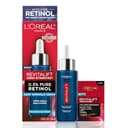
- A stated strength, where one exists. Four of the six picks publish a figure. The forehead tolerates more than the eye area or the skin around the mouth, so this is the part of the face where knowing the number is most useful rather than most frightening. Our percentages guide covers what to do when a brand will not print one.
- A base that suits an oilier zone. The forehead is part of the T-zone and runs oilier than cheeks on most faces. A heavy balm here is more likely to feel congested, which is why serums and fluid lotions dominate the list and the richest creams do not.
- Enough product for a large flat area.A forehead takes noticeably more than a nasolabial fold. The published fingertip-unit measure puts face and neck together at 2.5 units, where one unit covers roughly 286 cm² — a dermatological dosing measure for ointments rather than a retinol instruction, but the only published way to reason about how far a product has to go.
- The cost of ten months, not the cost of a bottle. See the timescale above. A product you ration is a product that never gets to the plateau.
- Fragrance-free, where the formulation is otherwise equal.Fragrance is among the commonest causes of allergic contact dermatitis, and the reaction can take hours or days to appear — the window in which people blame the retinol and stop.
How to actually apply it on a forehead
Clean, dry skin at night. A pea-sized amount for the whole face, spread thin, going into the hairline rather than stopping an inch short of it — the untreated band at the top is the most common reason people see a change in the middle of the forehead and not at the edges. Moisturizer over the top. Two nights a week for the first month, then three, then build. Our dose guide explains why more product does not mean more result.
Two forehead-specific cautions. First, if you wear a hat, a headband or a helmet on skin that is mid-adjustment, friction on flaking skin is its own problem. Second, people with a fringe or hairline acne tendency sometimes get congestion where product collects at the hairline — use less there rather than skipping the area. And the morning sunscreen is not optional, for the reason at the top of this page.
What we left out, and why
Eye creams. A forehead does not need the dose restraint the eye area needs, so buying an eye cream for it wastes money on a small jar. Those belong on our eye cream roundup.
Anything claiming to relax a muscle.No cosmetic on this site is ranked on a “topical botox” claim, here least of all, because the forehead is exactly where that claim gets made and exactly where it is least defensible.
Fragranced night creams that would otherwise have ranked, for the contact-dermatitis reason above. And body lotions, which are dosed for a different job entirely — see our body retinol roundup if that is what you are after.