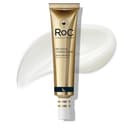
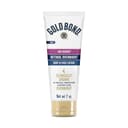
Why neck skin behaves differently
Three structural facts drive everything on this page. First, the dermis is thinner, so the same amount of retinoid produces a stronger effect — both the useful kind and the irritating kind. Second, there are fewer sebaceous glands, so the skin has less of its own lipid cushioning and dries out faster. Third, it is in constant motion and constantly in contact with fabric, which mechanically disrupts a surface that is already flaking.
Put together, that means the neck reaches the flaking stage sooner than the face at the same dose, and it looks worse when it does — there is no makeup routine that hides a flaky neck. The practical consequence is simple: whatever frequency you use on your face, start at half of it on your neck.
The chest is a third area again
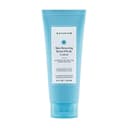
The decolletage takes more direct overhead sun than either the face or the neck, which is why it is often the most mottled and the most crepey of the three. It also has more surface area and sits under clothing that rubs. Treat it as body skin: heavier product, larger sizes, and no expectation that a face serum will stretch far enough. Our body lotion roundup covers the wider category and the cost-per-ounce arithmetic, and our Naturium body lotion review works through the size decision on the pick above.
How to apply retinol to the neck without flaking
- Start at one night a week. Not two, and definitely not nightly. Build to two nights after a month if nothing has flaked.
- Moisturize first, then treat, then moisturize again. The sandwich method was practically designed for this area, and there is very little downside to using it here from the start.
- Sweep upward and stop at the jawline, not below it. The transition zone under the jaw is where most people either miss entirely or double-dose by treating it as both face and neck.
- Go around the front of the throat lightly. The thinnest, most reactive skin on the neck sits over the trachea. Less product there, always.
- Extend to the chest in the same motion.If you are treating the neck, treat the decolletage — a treated neck above an untreated chest ages into an obvious line.
Sunscreen is not optional here
The neck and chest are where sun damage accumulates most visibly and where daily sunscreen is most consistently skipped. Adding a retinoid without adding sun protection is a poor trade: you increase photosensitivity on the skin that gets the most incidental exposure, and you leave the underlying cause of the damage running.
Apply sunscreen to the neck and chest every morning, in the same pass as your face, and use enough — dermatology guidance puts a face-sized dose at roughly a teaspoon, and the neck and chest together need at least as much again. Our retinol and sunscreen guide covers the quantities and the reapplication question.
What to expect, and when
Slower than the face. Thinner skin with less blood supply and constant mechanical disturbance does not remodel quickly, and the crepey texture people most want fixed is among the most stubborn things retinoids are asked to address. Realistically: some improvement in surface texture and tone by three months, changes in fine lines by six months and beyond, and limited change to genuine laxity at any point — sagging is a structural problem that topical actives do not solve.
What retinoids do reliably deliver here is a slowing of further change plus a measurable improvement in tone and mottling. That is worth having, and it is worth being honest that it is not a neck lift. Our crepey skin page sets out the mechanism and the realistic ceiling.
Are dedicated neck creams worth it?
Usually not, as a category. Most products sold specifically as neck creams are ordinary moisturizers with a premium price and a marketing story about a specific anatomy that has no formulation consequence. There is no ingredient that only works below the jaw. What genuinely matters is the same list as everywhere else: a real active at a sensible dose, a base that cushions, packaging that protects the retinoid, and a size that lets you actually cover the area.
The exception is worth stating fairly: a product explicitly formulated and sized for face, neck and chest is solving a real practical problem, which is that a 1 oz face serum does not stretch. That is a legitimate reason to prefer it — it is just not a claim about neck-specific chemistry.