Neither brand will tell you the strength
Start here, because it removes the comparison most people came for. CeraVe publishes no retinol percentage on either serum’s product page. RoC publishes no retinol percentage on the Deep Wrinkle Night Cream page or the capsules page. There is no figure to compare, on either side, and any article that gives you one for either brand has invented it.
That is not unusual — it is the norm in this category, and the reason this site keeps a “Not published” row in every spec table rather than filling the gap with a guess. It does mean the honest comparison has to be built out of what the brands do publish, which is the full ingredient list on all four products.
And there is a hard limit on what a list can tell you, worth stating once before we use it. Under the federal rule on cosmetic ingredient declarations, 21 CFR 701.3, a brand may list ingredients “present at a concentration greater than 1 percent, in descending order of predominance” and then list everything at “not more than 1 percent, without respect to order of predominance”. Every retinoid in every cosmetic is in that second group. So a list proves what is present and the rough tier of the things above 1%. It never proves how much retinol is in the bottle.
What is actually in each one
Read side by side, the two brands have made opposite formulation decisions, and that is the real content of this comparison.
CeraVe: everything around the retinol is buffering
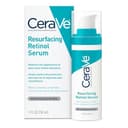
The Resurfacing serum’s published list runs water, propanediol, dimethicone, an emollient ester, then niacinamide fifth, then dipotassium glycyrrhizate (a licorice-root derivative), hydrogenated lecithin, and ceramides NP, AP and EOPtenth through twelfth. Retinol appears nineteenth, with sodium hyaluronate immediately after it and cholesterol and phytosphingosine further down. The brand states “Free of Added Fragrance” and “Won’t clog pores”.
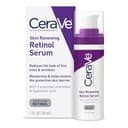
The Skin Renewing serum is built the same way with the order shuffled: the three ceramides at eleventh through thirteenth, niacinamide fifteenth, retinol twenty-third, hydrolyzed hyaluronic acid thirty-second, shea butter near the end. Also “Free of Added Fragrance”.
There is nothing in either formula whose job is to exfoliate, brighten by acid, or smell like anything. Whether or not you think niacinamide and ceramides earn their reputation, the intent of the formula is unambiguous: deliver a retinoid and support the barrier while it works. Our ceramide roundup covers why that pairing is the best-evidenced one in the category, and the hard caveat that no brand publishes a ceramide amount either.
RoC Deep Wrinkle Night Cream: everything around the retinol is also active
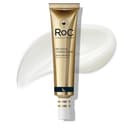
RoC’s published list for the 1 oz night cream runs water, dimethicone, glycerin, two emollient esters, a chelator, three fatty alcohols and emulsifiers, then retinol twelfth— the earliest retinol placement of any of the four, for whatever that is worth under the 1% rule. Then dihydroxy methylchromone, then magnesium aspartate, zinc gluconate and copper gluconate, which are the three minerals behind the “mineral complex” on the front of the box. Then shea butter, then glycolic acid, then ascorbic acid. And at the end: “Fragrance (Parfum), Linalyl Acetate, Trimethylbenzenepropanol, Tetramethyl Acetyloctahydronaphthalenes”.
That is a busy jar. Two of those additions matter enough to spell out.
- The fragrance is not incidental.The AAD names fragrance among the most common causes of allergic contact dermatitis, and notes the rash can take hours or days to appear — which is exactly the window in which people blame the retinol instead. Worth knowing too that the labels are not interchangeable: the AAD’s own explainer says “unscented” means a fragrance is masked so you cannot smell it, while “fragrance-free” means the product contains none. RoC declares both the blanket “Fragrance (Parfum)” allowance and three individual fragrance materials. This is a scented product.
- Glycolic acid plus a retinoid stacks photosensitivity. The FDA states that alpha hydroxy acids increase sun sensitivity; retinoids do the same thing by a different route. Neither fact makes a combined formula unsafe, and RoC directs you to build up every other night. It does mean morning sunscreen moves from good practice to a condition of using the product, and it means an evening routine where you also use an acid separately is doing the same thing twice. Our layering guide has the compatibility table.
RoC capsules: the brand’s own answer to its own formula
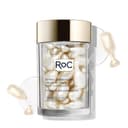
RoC publishes the capsules’ entire formula, and it is eight ingredients: cyclopentasiloxane, ethylhexyl cocoate, dimethiconol, soybean oil, retinol, dimethylmethoxy chromanol, ceramide NP, phenoxyethanol. No water, no acids, no fragrance — the brand page states “FORMULATED WITHOUT FRAGRANCE”.
The sealed format answers a measured problem rather than a marketing one. A validated HPLC study of sixteen retinoid derivatives across twelve commercial cosmetics found retinoid declines of 0% to 80% after six months at 25 °Cand 40% to 100% at 40 °C, with light degradation “more pronounced than temperature-induced degradation” and instabilities “associated with lower contents than declared in some cosmetics”. The study did not test any product on this page, so this is the category’s problem rather than a finding about RoC. But a single-dose capsule opened at the moment of use is a real response to it, which is more than most packaging claims can say. The full capsules review goes through it in detail.
The claims, and why RoC’s numbers are not the advantage they look like
Here is where the two brands diverge most sharply, and where readers get it backwards.
RoC’s night cream page publishes figures: up to 50% wrinkle reduction at twelve weeks, 96% had improvement in the look of deep wrinkles at twelve weeks, 100% had hydrated smoother-looking skin within minutes, 100% had younger-looking skin at four weeks. CeraVe’s pages publish no efficacy figure at all for either serum — just what the product is sold to address.
None of RoC’s four figures carries a sample size, a study design or a publication. “100% had hydrated, smoother looking skin” within minutes is a moisturizer result — it is what any decent cream does to the surface, and it tells you nothing about a retinoid, whose published effect on photoaged skin is measured over months and plateaus at around ten of them. A percentage with no denominator is a marketing asset, not evidence, and treating the brand that publishes one as better-supported than the brand that publishes none has the logic inverted.
The same standard cuts against CeraVe, to be fair: silence is not a virtue either. The honest summary is that neither brand gives you anything you could check, so the decision has to rest on the formula and the price — which is what the ranking above does. One ownership note, since it comes up: L’Oreal’s own brand portfolio lists CeraVe under its Dermatological Beauty Division alongside La Roche-Posay, Vichy and SkinCeuticals. We make no ownership claim about RoC, because we could not verify one to the standard this site uses. Either way, who owns a brand tells you about distribution and pricing, not about chemistry.
How to choose, in four lines
- Marks, texture, pores, or a tight budget— CeraVe Resurfacing. Cheapest here, fragrance-free, and sold for exactly those concerns.
- Fine lines and dullness— CeraVe Skin Renewing. The anti-aging one of the pair; the full review explains which of the two CeraVe serums you actually want.
- Reactive or fragrance-sensitive skin, and you like RoC— the capsules. Eight published ingredients, no fragrance, a sealed dose.
- You want one cream that does several things and fragrance is not a problem for you— the Deep Wrinkle Night Cream, every other night to start, with sunscreen every morning without exception.
What you should not do is treat the choice as drugstore-versus-drugstore and pick on price alone. These four products are within about $6 of each other. The thing that actually differs is what else is in the bottle, and on that, the two brands have given you a clear and documented answer.