How we ranked these
Roundups on this site normally open by asking whether the brand publishes a strength. That question still matters here, but it comes second. On a page about scarring, the first question is whether the product is aimed at the mechanism that is actually producing your marks.
- Does it treat the cause, not just the aftermath? The AAD’s own treatment page says that where breakouts are still present, the plan will likely begin with acne treatment, because stopping breakouts reduces inflammation and prevents new scars. A product that fades yesterday’s marks while tomorrow’s are still forming is a treadmill.
- Is there evidence for texture, or only for color? The retinoid scarring trials that exist used adapalene and trifarotene, not cosmetic retinol. That is a real distinction, and it is what moves one product to the top of this list.
- Does the base contribute to the marks themselves? Niacinamide and licorice root both appear in the dermatology literature on post-inflammatory hyperpigmentation, so a formula carrying them is doing two jobs rather than one.
- Is the strength stated? Fading takes months, and months of use means you will want to step up at some point. You cannot step up from a number you were never told.
One pick deliberately breaks the pattern. The Naturium body lotion is a moisturizer rather than a treatment serum, and its retinol figure is undisclosed. It is here because chest and back acne leaves marks too, and a 30 ml face serum will not cover a torso at any sensible cost. If your marks are all on your face, skip it.
What the evidence actually shows — and what it doesn’t
This is the part most roundups skip. There is real trial evidence that topical retinoids reduce atrophic acne scarring. There is almost none for over-the-counter retinol specifically, and an honest version of this page has to say so.
The strongest study is a 2018 split-face trial in 67 people with moderate or severe acne and at least ten atrophic scars, who used adapalene 0.3% with benzoyl peroxide 2.5% on one half of the face and vehicle on the other for 24 weeks. Total scar count fell 15.5% on the treated side and rose 14.4% on the untreated side— roughly a 30-point difference, a mean of 9.5 scars versus 13.3 per half face. A 2023 split-face trial of prescription trifarotene in 121 people found the same direction: a mean reduction of 5.9 atrophic scars against 2.7 on the vehicle side, with a measurable gap by week two.
Now the caveats, because they matter more than the numbers.
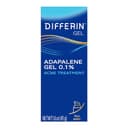
- None of those studies used retinol. They used adapalene at 0.3% and trifarotene — both prescription-strength in the US. The Differin gel you can buy off a shelf is adapalene at 0.1%, a third of the trial strength. It is the closest available thing to the tested molecule, not the tested product.
- All three trials were funded by the manufacturer. Galderma paid for every one. That does not make them wrong, and a split-face design with a vehicle control is a genuinely strong format — but you should know who paid.
- The 0.3% adapalene study with the eye-catching numbers had no control group. It was an open-label exploratory study: investigators judged 50% of subjects improved and subjects judged more than 80% of themselves improved, which is exactly the gap you would expect when everybody knows they are being treated.
- Much of the benefit is probably prevention. In the controlled trial the untreated side got worse. A large part of what the treated side achieved was stopping new scars forming, not filling old ones in.
The trifarotene authors put it neatly themselves: the efficacy of topical retinoids for acne is well documented, but the evidence for their use in atrophic acne scars is limited. For cosmetic retinol, the AAD’s wording is the ceiling to work from — if you have mild acne scarring, a retinoid or salicylic acid applied to the skin can make scarring less noticeable. Less noticeable. Not gone.
Which kind of mark do you have?
Worth five minutes with a mirror before you spend anything, because the answer changes what to buy — or whether to buy at all.
- Flat and discolored. Post-inflammatory hyperpigmentation. Not a scar. Fades over time, faster with treatment. This is the one retinol is for, and our dark spots page covers the mechanism in detail.
- Flat and white, or lighter than your skin. Hypopigmentation. Also not a scar. The AAD notes these usually fade and leave no trace, though it can take time. No retinol required.
- Small, deep, narrow pits. Ice pick scars — the AAD calls this the most common type. Deep and narrow is the worst possible shape for a topical to reach. Procedural territory.
- Wide, shallow, wavy dips. Rolling scars. Where a topical retinoid has the best chance of making a visible difference, and still a modest one.
- Round or oval craters with defined edges. Boxcar scars — wider than ice pick, narrower than rolling.
- Raised, firm, sometimes itchy or sore. Hypertrophic scars or keloids: too much collagen rather than too little, and more common in darker skin tones. Retinol does nothing useful here. These are treated with corticosteroid injections, lasers or surgery.
If you are unsure, the useful test is light. Pigment looks the same from every angle. A scar changes as you tilt your face, because what you are seeing is a shadow rather than a color.
And if the honest answer after that exercise is “none of these — my skin is just rough and uneven”, you are on the wrong page in a useful way. That is a different problem with a much better prognosis, and our page on retinol for textured skin covers it.
Stop the acne first — it is the highest-yield thing on this page
The AAD lists three risk factors for scarring: deep, painful acne; a close blood relative who has or had acne scars; and picking, popping, squeezing or scratching your breakouts. You cannot change the second. You can change the other two, and doing so is worth more than any serum on this list.
Their prevention advice is to treat acne when you first notice it and keep treating it, because preventing acne prevents acne scars — treating mild acne early means the deeper breakouts that are more likely to scar never develop. The instruction on picking is unqualified: never pick, pop, scratch or squeeze, because each of those increases inflammation, and the more inflamed the skin, the more likely a scar.
That is why over-the-counter adapalene sits first here rather than a nicer cosmetic serum. It is regulated as a drug, its strength is printed on the box, and it is aimed at the breakouts still manufacturing new marks. Our full review covers what the adjustment period genuinely feels like, and our retinol for acne page covers the wider question of where retinol fits against active breakouts.
A realistic timeline
Plan in months. Both controlled scar trials ran for 24 weeks, and the trifarotene study was notable partly because it could detect any separation from vehicle as early as week two — which tells you a two-week difference was surprising enough to report.
For the flat marks the honest horizon is longer than product marketing implies. The AAD’s guidance on fading dark spots puts a spot a few shades darker than your natural skin color at six to twelve months, with deeper discoloration taking years. In acne specifically, the clinical review literature notes that the marks are often more distressing to patients than the acne was, and that acne lesions typically improve weeks before the pigmentation does. That gap is where most people wrongly conclude the routine has stopped working.
Two practical consequences. Judge a product on whether you will still be using it in April, not on what it does in three weeks — a formula you tolerate nightly beats a stronger one you abandon. And protect the ground you gain: new sun exposure and new breakouts both re-deposit the pigment you just spent months clearing. Our retinol and sunscreen guide covers how much product actually counts as a dose.
Do not over-treat marks in the name of clearing them
The failure mode on this page is specific: someone with post-acne marks buys the strongest thing on the shelf, irritates their skin, and the resulting inflammation lays down more pigment. Retinoid dermatitis can itself induce post-inflammatory hyperpigmentation, and post-inflammatory hyperpigmentation affects darker skin more frequently and more severely. The way out is the same route that made the marks.
- Two or three nights a week for the first month. Our frequency guide has the full ramp. On this page, hold each step an extra week.
- Sandwich it from the first night if your skin is reactive. Moisturizer, retinoid, moisturizer — our sandwich method guide has the technique.
- Do not scrub. The AAD is blunt that scrubbing and strong soaps worsen acne. A scrub layered onto a retinoid routine is simply more inflammation, and inflammation is what leaves marks.
- Stop anything that stings every time. Tingling that settles in a minute is ordinary adjustment. A product that burns on every application is telling you something.
- Sunscreen every morning, without exception. Photoprotection is first-line throughout the pigmentation literature, and it is the half of the routine people quietly drop.
If you do go the procedural route, the retinoid question does not disappear — it changes shape. A retinoid has to stop before the appointment and must not go back on freshly treated skin, and the window at each end is set by the person holding the device. Our retinol and microneedling guide sets out both windows and the restart rule.
What we left out, and when to see a dermatologist
Vitamin C serums, exfoliating acids and “scar” gels. Reasonable products, and none of them is a retinoid, which is what this site covers. Our retinol versus vitamin C comparison sets out where the two actually differ.
Silicone sheets and pressure garments. These belong to raised scarring, which is a different problem with different treatment, and they are not retinoids.
At-home microneedling rollers. Deliberately excluded. Microneedling is on the AAD’s list of treatments for depressed scars — performed by a dermatologist, often combined with radiofrequency or platelet-rich plasma. Puncturing already-scarred skin at home, on top of a retinoid, is a way to add inflammation to a problem inflammation caused.
And the honest handoff. If your scars are indented or raised rather than flat, the treatments with real evidence are procedural: chemical peels, fillers, laser resurfacing, microneedling, radiofrequency, scar surgery and dermabrasion. The AAD notes that medical insurance does not cover the cost, so this is a budget decision as much as a medical one — which is a good reason to know, before you spend, that a cheap serum was never going to substitute for it. Deep, painful or cystic acne is also a reason to see a dermatologist now rather than after it scars. This page is general information, not medical advice.