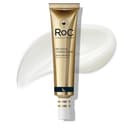
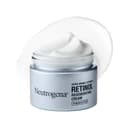
Where they genuinely differ
Fragrance
This is the single biggest practical difference, and for a lot of readers it settles the question on its own. The RoC night cream is fragranced. Neutrogena’s is fragrance-free. Fragrance is not inherently harmful, and plenty of people use fragranced retinol nightly with no issue at all — but it is a common irritant, and retinol already asks your barrier for patience. If your skin is reactive, or if you are introducing a retinoid for the first time, the fragrance-free option removes a variable. Our sensitive-skin roundup weights this heavily for the same reason.
What it replaces in your routine
Neutrogena is explicitly a treatment-and-moisturizer in one. Apply it and you are done. RoC is a treatment night cream that most people layer a moisturizer over or under, particularly in the early weeks. Neither approach is superior; they are different amounts of routine. If you want one step, that is a real argument for Neutrogena. If you already have a moisturizer you like and want the retinol to be a separate, controllable layer, RoC fits better.
Texture and skin type
RoC’s night cream is the richer of the two, which suits drier and more mature skin and can feel like too much on oily or combination skin. Neutrogena’s is lighter and absorbs faster. If you are oily and want a drugstore retinol, a serumis often the better format than either — both of these are creams first.
Track record
RoC has the longer retinol history and a reputation built on this specific product line. That is not evidence in the clinical sense — neither brand publishes trials you can read against a competitor — but longevity in a category where products churn constantly is worth something. Neutrogena’s line is broader, with a serum, an eye version and several tiers, so it is easier to stay within one range as your needs change.
Packaging
Worth a line, because retinol degrades in light and air. Jars are the worst format for a retinoid and tubes and pumps are better. Check the specific SKU you are buying — both brands sell across formats — and prefer the sealed one where you have a choice.
The unstated-strength problem
Neither product tells you how much retinol is in it, and that is a genuine limitation rather than a nitpick. It means three things. You cannot compare them to each other on potency. You cannot tell whether you are starting at the equivalent of a 0.1% or a 0.5%. And when you eventually want to step up, you are stepping from an unknown, which can make the jump much bigger than you intend — someone moving from an unstated drugstore cream to a stated 1% could easily be tripling their exposure without realizing.
If that bothers you, and it reasonably might, the drugstore shelf does contain stated-strength options — our drugstore roundup singles out the two that print a number, and our strength guide explains what those numbers mean.
Which should you buy?
Choose RoC if…
- Your skin is dry or mature and you want a genuinely cushioning night cream.
- Fragrance has never bothered you.
- You want the product with the longest track record in this specific category.
- You are happy layering your own moisturizer around it.
Choose Neutrogena if…
- Your skin is reactive, or this is your first retinoid.
- You want fragrance-free without paying pharmacy prices.
- You want one step at night rather than two.
- You prefer a lighter finish.
Choose neither if…
You want to know what strength you are using. Both are perfectly reasonable products and both are opaque about the one specification that would let you use them deliberately. If precision matters to you more than convenience, a stated 0.2% or 0.3% costs the same or less. That is the whole editorial position of this site in one sentence.
How to use either of them
Identically. At night, on clean, fully dry skin, a pea-sized amount for the whole face, starting at two nights a week and building over several weeks as our frequency guidesets out. Moisturize on top — yes, even with the one that includes a moisturizer, in the first fortnight. Keep it away from the immediate eye area unless you are using a product formulated for it. Sunscreen every morning. Both brands make an eye-area version if that is where your concern is — see our eye cream roundup.
One more pairing worth reading if Neutrogena is the side you are leaning toward: our CeraVe vs Neutrogena comparison puts it against the other big drugstore name and turns on the same format question — a treatment serum you pair with your own moisturizer, against a retinol moisturizer doing both jobs in one step.