The finding: one line, two fragrance positions
Read the five listing titles side by side and something odd appears. The Moisturizer carries Fragrance-Free in its own product name. The Pro+ eye cream goes further and states “Formulated without Fragrance, Dyes, Phthalates, and Parabens” in its title. The standard eye cream, the standard face serum and the Pro+ face serum say nothing about fragrance in either direction. Same brand, same line, same shelf, three products silent and two making the claim.
Our spec tables below record that silence as “Not published” rather than guessing. That is a correction we made to this site’s own data: both Neutrogena eye creams had been recorded as containing fragrance since our launch batch with no source behind it, and when we went back to check, the Pro+ title turned out to publish the opposite claim while the standard one was genuinely silent. Asserting a fragrance a brand has not declared is the same failure as asserting its absence — it just errs in the direction that looks cautious.
Why weight this so heavily on a retinol page? Because fragrance is among the commonest causes of allergic contact dermatitis, and that reaction is frequently delayed— it appears hours or days after exposure. Which puts it exactly inside the window where a new retinoid user expects some adjustment, assumes the stinging and flaking is the retinol, and stops. The published retinoid record plateaus at roughly ten months of continuous use, so quitting in week three is the main way a retinol fails. If you already know fragrance is a problem for you, that single column decides this page.
What “accelerated retinol SA” and “Pro+” actually mean
Credit where it is due: Neutrogena specifies pure retinol on these listings rather than a retinyl ester. That matters more than it sounds. A retinyl ester needs three conversion steps inside skin to become retinoic acid, the only form that does anything; retinol needs two. A product marketed as a retinol whose active is actually retinyl palmitate is the weakest thing on any shelf, and our retinyl palmitate comparison covers that trap. Neutrogena is not doing that here.
What the brand’s own language does not tell you is quantity. “Accelerated retinol SA” names a blend. “Pro+” names a tier. Neither is a dose, and nothing requires a cosmetic brand to publish one: the federal rule on cosmetic ingredient lists orders ingredients by predominance only above one percent, and everything below that line may be listed in any order. Every cosmetic retinoid sits below that line. So even a complete ingredient list would not yield a percentage here — position proves presence, and never amount.
That is why we will not rank these five on strength, and why any page that does is making the number up. Our strength and percentages guide explains what a published figure buys you and what its absence really tells you.
The criteria, in order
- Published fragrance status, weighted heavily. Two of five make the claim. For reactive skin this is the decision, for the delayed-reaction reason above.
- Does the product buffer itself? A moisturizer carrying a retinoid treats and cushions in one step. A serum asks you to bring the moisturizer, which is more control and one more thing to get right.
- Format fit for the area being treated. An eye-dosed formula for the eye area, a face product for the face. Neither is better in the abstract, and a 14 ml eye cream is not a cheap way to treat a face.
- What else is in the formula, as published. Hyaluronic acid in the standard serum, emollients in the Pro+ serum. Both are real; neither is a dose.
- Cost of a ten-month run, not cost of a bottle.The published improvement curve runs most of a year, so the product you keep re-buying is the one that works. Every pick here is drugstore-priced, which is the brand’s real advantage.
- No credit for tier names.“Pro+” does not move a product up this list on its own.
The five, and who each is for
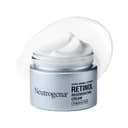
Rapid Wrinkle Repair Retinol Moisturizer — the one to buy
Our top pick, on two published facts rather than on a claim. First, the title states fragrance-free, which no other face product in the range does. Second, it is a moisturizer, so it is doing the buffering itself — the single biggest predictor of whether someone sticks with a retinoid is whether the routine is one step or three. At 29 ml it is the smallest face size here, which is the honest objection: a 1 oz jar of night moisturizer used nightly does not last long, and you will be re-buying. It is also the pick that commits you to the brand’s choice of base rather than your own.
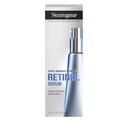
Rapid Wrinkle Repair Retinol Face Serum — the budget pick
The cheapest way into the brand’s face range and the version most people mean by “the Neutrogena retinol serum”. Retinol with hyaluronic acid, 1 fl oz, at drugstore money. Worth being precise about what the hyaluronic acid does: it is a humectant, so it holds water in the stratum corneum. That addresses the feel of retinoid dryness, which is useful, but it is a different job from replacing a barrier lipid — which is what a ceramide does, and why our ceramide roundupexists as a separate page. The cons are the range’s cons: no percentage, and no fragrance claim either way.
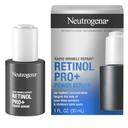
Rapid Wrinkle Repair Retinol Pro+ Power Facial Serum — the top tier
If you want the thing Neutrogena itself positions as its strongest face formula, this is it: the Pro+ tier, in a serum, with pure retinol and nourishing emollients per the listing, non-comedogenic and paraben-free. It is also the most expensive face product the brand sells on this site. We rank it third rather than first for one reason, and it is not a formulation objection: the premium buys you a tier name and no additional disclosure. It publishes no percentage, and unlike the moisturizer and the Pro+ eye cream it makes no fragrance-free claim. Paying more for less published information is the wrong direction, so it earns its place as the answer to a specific question rather than as the default.
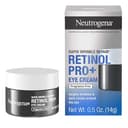
Rapid Wrinkle Repair Pro+ Retinol Eye Cream — for the eye area
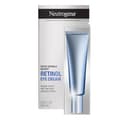
The better of the brand’s two eye creams, and the clearest example of the fragrance finding: its own title states it is formulated without fragrance, dyes, phthalates and parabens. At 14 ml it is sized for two eyes, which is correct — eye-area product is not a cheap route to treating a face. One caveat we will not bury: when we last checked this listing it returned a live price but an empty availability string, which is why our 2026-11-07 Neutrogena review was built on the plain eye cream instead of this one. Check the button before you commit.
Rapid Wrinkle Repair Retinol Eye Cream — cheapest, with a caveat
The cheapest product in the range, and a perfectly reasonable buy if crow’s feet and under-eye lines are the complaint. The caveat is the one this whole page turns on: it is silent on fragrance where its Pro+ sibling publishes the claim. If you have no fragrance sensitivity, that silence costs you nothing and this is the value pick in the range. If you do, pay the few dollars more for the Pro+ version. Its full reviewworks through what an eye cream can and cannot reach — fine lines and crepey texture yes, slowly; dark circles only where the cause is pigment rather than a hollow or vessels; eye bags and hooding not at all.
Which one, by situation
You avoid fragrance: the Moisturizer for the face, the Pro+ for the eyes. Those are the only two products in the range that publish the claim. Our fragrance-free roundup compares them against every other brand on this site.
You want one product and one step: the Moisturizer. You already have a moisturizer you like: the standard serum, layered under it.
You want a stated percentage: not this brand, at any price. Go to The Ordinary for a published figure on every rung, or our high-strength roundup if you are already tolerant and want to buy a real dose deliberately.
You want ceramides doing the buffering instead of a humectant: CeraVe’s range, where all three products are fragrance-free and the base does more work. Our CeraVe vs Neutrogena head-to-head is the direct comparison.
You are new to retinoids entirely: start at our beginner picks, which rank on the ramp rather than on the brand, and come back if a drugstore moisturizer-plus-retinoid is the format you want.
What a Neutrogena retinol will and will not do
The evidence that makes any retinoid worth using is not Neutrogena’s. It is prescription tretinoin: a double-blind study showing epidermal hyperplasia, compaction of the stratum corneum and new collagen fibrils in the papillary dermis, with the changes building and peaking at around ten months; and a controlled trial in which collagen I formation rose 80% on daily tretinoin against a 14% fall on vehicle. No cosmetic retinol on this site, from this brand or any other, has a published trial of its own. What these products inherit is the mechanism and the requirement to keep going.
So: fine lines, surface texture and tone, gradually, over months. Not deep wrinkles. Not laxity — the AAD’s own position is that a cream or lotion cannot penetrate deeply enough to lift sagging skin, and that firming-cream results are subtle at best. And not faster because the box says “rapid”; that word describes the marketing, and the one thing on the label that reliably works quickly is the cosmetic finish of the base.
One myth worth killing while we are here, because it comes up with every eye cream: retinol does not thin the skin around your eyes. The histology runs the other way — epidermal thickening and a compacted stratum corneum — and retinoids have been shown to offset steroid-induced skin atrophy rather than cause it. Our guide on that has the detail.
How to use one of these
Two nights a week for the first month, on dry skin after cleansing, a pea for the whole face, moisturizer over the top, sunscreen every morning without exception — a retinoid raises sun sensitivity, and the damage it is working against is largely photodamage, so the sunscreen is part of the treatment rather than an add-on. Around the eyes, apply on the orbital bone rather than the lid, and use less than you think. Our dosing guide has the fingertip-unit arithmetic, and our routine guide has the full order of operations.
One storage note that applies to the whole range: retinol degrades, and a validated study of sixteen retinoid derivatives across twelve commercial cosmetics measured losses of 0% to 80% after six months at 25 °C and 40% to 100% at 40 °C, with light degradation worse than heat. These are tubes and jars rather than airless pumps. Keep them in a drawer, not on a sunny windowsill, and finish them.
What we left out
Neutrogena’s non-retinol products.The brand’s cleansers, sunscreens and hydro boost range are out of scope for a ranked retinoid list, however good some of them are.
Any ranking by strength. Covered above: there is no published figure for any of the five, and an ingredient list cannot supply one.
Products we could not price or confirm.We will not rank a product the daily check cannot price, and we flag an ambiguous availability string rather than quietly ignoring it — which is why the Pro+ eye cream carries a stock caveat rather than a silent pass.