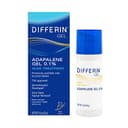
The comparison, at a glance
Regulatory status
Adapalene is regulated as an over-the-counter drug in the US; retinol is a cosmetic ingredient. This is not bureaucratic trivia. Drug status means a defined indication, standardized labeling, a stated concentration and a trial dossier. Cosmetic status means the brand chooses what to tell you, which is why the transparency question runs through every page on this site.
Mechanism
Adapalene binds retinoic acid receptors directly. Retinol must be converted twice — to retinaldehyde, then to retinoic acid — and material is lost at each step. That makes adapalene the more potent of the two at comparable doses, which is part of why it works on acne where retinol largely does not. Our retinol vs retinoid page maps the whole family, and retinol vs retinal covers the intermediate rung.
Evidence
Adapalene has the acne evidence. Randomized trials and a meta-analysis of five of them found adapalene 0.1% gel comparable to tretinoin on lesion reduction with noticeably better local tolerability — less erythema, dryness and stinging — and better patient preference. Retinol has the photoaging evidence: reviews of topical retinol document effects on collagen and the appearance of photoaged skin. Each is strong in its own lane and thin in the other’s.
Tolerability
This one surprises people. Adapalene is more potent than retinol but is also notably better tolerated than tretinoin, and it is more photostable than most retinoids. It is not gentler than a low-strength retinol — expect a genuine adjustment period of dryness and peeling for several weeks — but it is far from the harshest thing in the family, and the trial data on tolerability is unusually good for a retinoid.
Formulation options
Retinol wins here comfortably. It exists in serums, creams, oils, body lotions, eye formulations and encapsulated delivery systems, buffered with niacinamide, ceramides or bakuchiol, at strengths from 0.2% to 1%. Adapalene comes as a gel at 0.1%. If your skin needs a particular texture or a specific supporting formula, that is a real constraint.
Which one do you actually need?
Buy adapalene if…
- You have active acne — blackheads, whiteheads, inflamed spots, congestion.
- You have tried a retinol for acne and it did not do much.
- You want a stated strength and a regulated product rather than a cosmetic with an undisclosed dose.
- Cost per month matters — a 45 g pump lasts a long time at a pea-sized dose.
Buy a retinol if…
- Your concerns are fine lines, tone, dullness or photoaging rather than acne.
- Your skin needs a specific base — a cushioning cream, a buffered serum, an eye formulation, a body lotion.
- You are building tolerance from scratch and want to start at a genuinely low stated strength.
- You want to treat the neck, chest or body, where adapalene is not the tool.
The overlap case
Plenty of people have both problems — occasional congestion plus the beginnings of fine lines. Two reasonable approaches: use adapalene as the sole retinoid, since it addresses congestion and, being a retinoid, contributes to texture and tone as well; or treat the acne with adapalene until it is controlled, then transition to a retinol for the anti-aging phase. What is not sensible is using both simultaneously. They are the same class doing the same job at the same receptors, and stacking them multiplies the irritation without multiplying the result.
How to switch between them
Treat the switch as starting from scratch, in either direction. Tolerance to one retinoid at one dose does not transfer cleanly to another molecule — someone comfortable on a 0.2% retinol nightly should still start adapalene at two or three nights a week and build. Apply to clean, fully dry skin; a pea-sized amount covers the whole face; moisturize on top. Our frequency guide applies to both.
Do not layer either one with exfoliating acids in the same routine while building tolerance, and keep strong vitamin C to the morning — the layering guide covers what combines safely. Sunscreen every morning applies to both, though adapalene is the more photostable of the two in the bottle.
What about tretinoin?
Tretinoin is retinoic acid itself, prescription-only, and the most potent and most irritating of the three. Adapalene sits between retinol and tretinoin on potency but beats tretinoin on tolerability in head-to-head trials, which is a large part of why it was the retinoid that made it over the counter. If adapalene is not enough, that is the conversation to have with a dermatologist — our retinol vs tretinoin page covers what crossing that line involves.