Which property are you replacing?
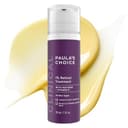
CLINICAL 1% Retinol Treatment bundles four things. Almost nobody needs all four, and every alternative below is cheaper precisely because it keeps some and drops others.
If you are replacing the stated 1%
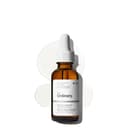
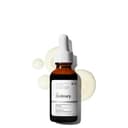
Take The Ordinary Retinol 1% in Squalane. Same published figure, same 30 ml, fragrance-free, and a fraction of the cost. The difference is what surrounds the retinol: squalane and nothing else, against a lotion carrying peptides, vitamin C and liquorice extract. On the evidence, that is a smaller loss than it sounds. The cosmeceutical literature sorts skincare peptides into signal, neurotransmitter-affecting and carrier groups by what they are claimed to do, and reviews of photoaging treatments put retinoids in the first tier with peptides as supporting players. You are buying a retinoid; the rest is a reasonable extra rather than the reason it works. Our direct head-to-head of these two is the long version, and our retinol vs peptides page is the evidence in full.
One honest caveat: a bare 1% in an oil base can feel sharper than a 1% in a cushioned lotion, at the same stated figure. If you have been using the original comfortably, start the swap at your current frequency rather than increasing it, and keep a moisturizer over the top.
If you are replacing the supporting actives and the comfort
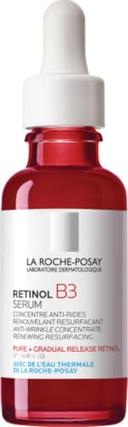
Take La Roche-Posay Pure Retinol, at roughly the same price. Niacinamide has its own published record — on barrier function and on tone, separately from the retinoid — and pairing it with retinol inside one bottle is the most practical kind of buffering there is. It is also fragrance-free, which we weight heavily: fragrance is among the commonest causes of allergic contact dermatitis and the reaction is often delayed by days, which is exactly the window in which people blame the retinoid and quit. What you lose is disclosure. Its full review is blunt about that.
If 1% is more than you need
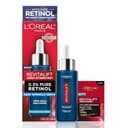
Most people using a stated 1% do not need to be. The published record plateaus at around ten months of continuous use rather than rewarding a higher dose faster, and the commonest way a retinoid fails is that someone stops. Two sensible rungs down: L’Oreal’s Revitalift at a stated 0.3%— the only drugstore serum on this site that prints a figure, though it does contain fragrance — or The Ordinary’s own 0.5%, which is where we think most people should settle. Our step-up guide covers how to know, and our high-strength roundup is the page for when you are genuinely ready.
If 1% already proved too much
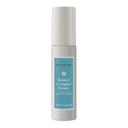
Two different levers. Change the base: Naturium’s Retinol Complex pairs encapsulated retinol with bakuchiol in a cushioned serum for well under twenty dollars — which also answers the bakuchiol question people ask about this brand specifically. Treat bakuchiol as support rather than a substitute: it has a small supportive literature against retinol’s much larger one, and our retinol vs bakuchiol page keeps it at that distance. Or change the molecule: The Ordinary’s Granactive Retinoid 2% Emulsion uses hydroxypinacolone retinoate, an ester that binds receptors without the conversion chain. Be aware the 2% describes the complex, not the active, and the one citable study is an open pilot of 0.1% HPR plus 1% encapsulated retinol whose own authors called for a controlled trial.
What none of these alternatives give you
Peptides, vitamin C and a stated 1% in one bottle.That specific combination is the original’s own thing, and nothing cheaper on this site reproduces it. If you want all of it, the original is the product, and our peptides roundupshows how short the list of published alternatives actually is — three products in a registry of forty-odd.
An air-restrictive tube. The Ordinary ships a dropper bottle. If packaging-driven stability is your concern, the structural answer is a sealed single-dose format rather than a cheaper tube; our encapsulated roundup covers those.
A trial of its own.Neither the original nor any alternative here has one. The record the whole category borrows from is prescription tretinoin — new collagen fibrils and stratum corneum compaction peaking at about ten months, and collagen I formation up 80% on daily tretinoin against a 14% fall on vehicle — and no cosmetic retinol inherits those numbers. There is one study worth knowing about that sits closer: a twelve-week double-blind comparison that escalated a retinol serum through 0.25%, 0.5% and 1% against tretinoin cream, finding the two at parity at week 12 with greater epidermal thickening in the retinol group. It was industry-adjacent cosmetic research rather than an independent trial, and it tested neither of these products.
How to switch without a setback
Match frequency, not just figures. Swapping one stated 1% for another, keep the same number of nights per week for a month before changing anything — the base is different even where the percentage is identical. Moving down to a 0.3% or 0.5%, you can keep your current frequency immediately. Moving to a different molecule, treat it as a new product and go back to two nights a week. Moisturizer over the top every time, sunscreen every morning, and nothing else new in the same fortnight. Our routine guide has the full order of operations.