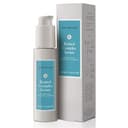
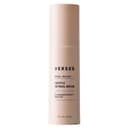
What “combination” actually describes
Sebaceous glands are not evenly distributed across a face. They cluster on the forehead, nose and chin — the region the industry calls the T-zone — and thin out across the cheeks and along the jaw. Almost everybody has some version of this gradient. It gets called combination skin when the difference is large enough that one product stops being right for the whole face.
Two consequences follow, and they pull in opposite directions. Sebum is itself mildly occlusive, so an oily zone retains water better and tolerates a drying active more easily. And a zone with more oil has more of the congestion a retinoid is good at clearing. So the T-zone both wants the retinoid more and minds it less. Your cheeks are the constraint, and any sensible plan is built around them.
One thing to rule out before you go further: skin can also be dry and oily at the same time for a reason that is not anatomy. Over-cleansing, a foaming wash used twice daily on skin that does not need it, or an alcohol-heavy toner will strip the cheeks while the T-zone compensates by producing more oil. If your combination pattern appeared after a routine change rather than being the way your face has always behaved, fix the cleanser before you buy a retinol. Our retinol mistakes guide covers the over-cleansing trap in more detail.
The criteria
The ranking is argued rather than scored — we own none of these units and we do not pretend to. In order of weight:
- A base that is neutral in both zones. The single most important filter. A fluid or light lotion-serum can be layered over on the cheeks and left alone on the T-zone. A rich cream cannot be un-enriched, and an anhydrous oil serum cannot be made non-greasy. This is why The Ordinary’s squalane ladder, the budget favorite almost everywhere else on this site, is not the top pick here.
- Buffering actives in the formula. Ceramides, niacinamide, panthenol and centella all support the barrier that the cheeks are short of. The AAD names ceramides and hyaluronic acid specifically as ingredients to look for. A retinoid that arrives with them attached needs less help from the moisturizer step, which is the step you may be skipping in the middle of your face.
- Nothing that will clog the T-zone. Heavy butters, mineral oil and thick silicone finishes are all fine on a dry cheek and a liability on a congested forehead. The AAD’s own oily-skin guidance is to look for products labeled oil-free and noncomedogenic, and to moisturize anyway.
- A dose you can control. Droppers and pumps let you put a different amount in each zone. A jar with a thick cream encourages one uniform layer, which is exactly what we are trying to avoid.
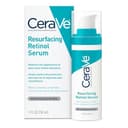
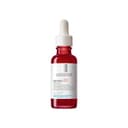
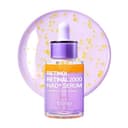
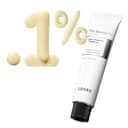
- Honesty about strength. As everywhere on this site, a brand that publishes its percentage gets credit for it. Two picks below do; four do not, and their spec tables say “Not published” rather than a guess.
How to apply one retinol two ways
This is the part that matters more than which bottle you buy. The method below is the standard nightly routine with one change: the moisturizer step is applied unevenly on purpose.
- Cleanse and dry completely. Retinoids penetrate faster into damp skin, and faster means more irritation on the half of your face that can least afford it. Give it a few minutes.
- Moisturize the cheeks first, and only the cheeks. A thin layer of a plain cream on the dry zone before the retinoid is the sandwich method applied to one region. It measurably softens the dose where you want it softened, and leaves the T-zone getting the retinoid neat. Our sandwich method guide explains the technique in full.
- Apply the retinol across the whole face, but not evenly. A pea is still the total dose for a whole face. Place most of it on the T-zone and spread what is left outward. Do not apply extra to compensate for the buffering layer — see how much retinol to use for why more product does not mean more result.
- Moisturize the cheeks again. Leave the center bare. This is the AAD’s advice in practice. If the T-zone genuinely feels tight afterwards, a light gel there is fine — but check first whether it is tight or just used to being coated.
- Sunscreen the next morning, everywhere. That step is not zoned, and it is not optional with any retinoid. Our sunscreen guide covers what to use while your skin is adjusting.
Frequency follows the cheeks, not the T-zone. Two nights a week for the first month regardless of how comfortable your forehead is, then three, then judge. If only the cheeks are protesting, the answer is more buffering on the cheeks rather than fewer nights overall.
What we left out, and why
The Ordinary’s squalane serums. They are the best-value stated-strength retinols on the market and they top several other lists here. The base is the problem: pure retinol dispersed in an oil, with a finish that people with a congested T-zone consistently dislike. If you want that exact transparency and your oiliness is mild, the 0.2% is a reasonable buy — just expect the texture to be the thing you notice. Our oily-skin roundup makes the same call.
Rich night creams. Every cream on the creams roundup is a good product and none of them belong on a combination face as a single all-over step. If you love a cream texture, use it as the cheek-only moisturizer in step two and let a lighter serum carry the retinoid.
Adapalene gel. If the T-zone problem is genuinely acne rather than shine and visible pores, an over-the-counter adapalene is a stronger and more targeted tool, and it can be used on the T-zone alone. That is a treatment decision rather than a skincare one — our acne-prone roundup and retinol vs adapalene comparison both cover it.
Anything sold specifically “for combination skin”. There is no formulation standard behind that phrase, and no product was included or excluded here on the strength of it. Every pick earned its place on its published base and ingredient list.
Setting expectations
A retinoid will not change your sebum distribution. Combination skin is largely anatomical, and no over-the-counter product moves the oil glands around. What it can do is address what the oily zone actually complains about — congestion, visible pore size, uneven texture — while doing the usual long-term work on tone and fine lines across the whole face.
On timing, be patient in the way the evidence supports. Texture changes show up first, usually somewhere in the second or third month. The long-run photoaging benefit builds over the better part of a year. Our results timeline guide sets out what is reasonable to expect and when.