Why this is a different buying problem
Most skincare advice assumes your skin is one thing. In the transition years it is often two contradictory things in different places at the same time: congestion and breakouts along the jaw, chin and sometimes the neck, alongside skin on the cheeks and around the eyes that has started to feel tight, look less dense, and sting at products that used to be fine.
That combination defeats the obvious purchases in both directions. Buy for the breakouts and you reach for a drying gel, a foaming cleanser and a toner, and the dry half gets worse. Buy for the thinning and you reach for a rich night cream, and the congested half gets worse. A retinoid is unusually well suited to this moment precisely because it is the one active with a claim on both problems — the acne literature and the photoaging literature are both retinoid literatures — but which retinoid and in what base becomes the whole decision.
Our ranking therefore favours products that do the treating and the cushioning in one bottle, and treats single-purpose products as specialist tools rather than defaults.
What the published record supports, and where it stops
Reviews of estrogen-deficient skin describe collagen, elasticity and barrier changes following menopause, and the cosmeceutical reviews of options for post-menopausal skin include retinoids among the topicals worth considering. The underlying retinoid evidence is stronger still but it comes from elsewhere: a double-blind study in which prescription tretinoin produced epidermal hyperplasia, compaction of the stratum corneum and new collagen fibrils in the papillary dermis, peaking at around ten months, and a controlled trial in which collagen I formation rose 80% on daily tretinoin against a 14% fall on vehicle.
Three limits worth stating. That record is prescription tretinoin, not cosmetic retinol. It is not specific to the transition years. And the ten-month plateau is the single most useful number on this page, because it tells you the thing to optimise for is continuing— not strength, not price, not a new product every season.
On the acne half
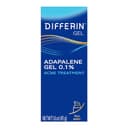
Adult breakouts in this period commonly sit along the jaw and chin rather than across the forehead, and the AAD’s own adult-acne material is the place to start on why adult acne is treated differently from teenage acne. For a topical, adapalene is the strongest over-the-counter option and it is a genuine third-generation retinoid rather than a precursor. Two honest caveats: its evidence base is acne, not lines, so we will not transfer the collagen record to it; and it is drying, which is the opposite of what the other half of your face needs. If you use it, use it where the breakouts are rather than all over, moisturize afterwards, and read the sandwich method for how to blunt a retinoid without wasting it. Our retinol for acne page is the full treatment.
If breakouts are intermittent rather than constant, the better plan is usually one buffered retinoid everywhere — which is what our first pick is — and something targeted for flares, rather than two competing routines.
On the dryness half
The practical fix is not a weaker retinoid, it is a better base and a slower ramp. Niacinamide and ceramides in the same bottle as the retinol do real work; the AAD’s own dry-skin guidance on moisturizing immediately after washing does more than most product choices. And fragrance is worth avoiding here more than at any other life stage: it is among the commonest causes of allergic contact dermatitis, the reaction is frequently delayed by hours or days, and if your skin has already become unpredictable you will not be able to tell a fragrance reaction from retinoid adjustment. Four of our six picks are fragrance-free; the two that are not are flagged in their spec tables.
Do not forget the neck and jaw line
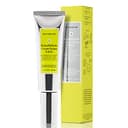
A 30 ml face serum is dosed for a face. If the jaw, neck and chest are part of what is bothering you, the arithmetic does not work from a face bottle, which is why Naturium’s stated 0.10% retinal in a 50 ml cream serum is on this page — it is explicitly sized for face, neck and chest. Our neck and chest roundup covers that problem properly, and our how much to use guide has the fingertip arithmetic.
The criteria, in order
- Treats both halves, or is honest about treating one. A product that works on congestion and supports a struggling barrier outranks a better product that only does one.
- Buffering actives in the bottle— niacinamide, ceramides, hyaluronic acid — because the ramp is harder when skin is already reactive.
- Fragrance-free, weighted heavily, for the delayed-reaction reason above.
- A stated strength where it exists, because unpredictable skin is exactly when you want to know your dose.
- Enough product for the area you are treating, including the jaw and neck.
- Cost of a ten-month run. The plateau is at about ten months, so the bottle you keep rebuying is the one that works.
Which one, by situation
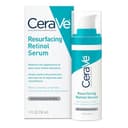
Breakouts and new dryness together: the CeraVe Resurfacing serum, two nights a week to start. Its full review explains what encapsulation does and does not promise.
Breakouts dominating: Differin on the affected area, with a moisturizer after, and read retinol for acne-prone skin.
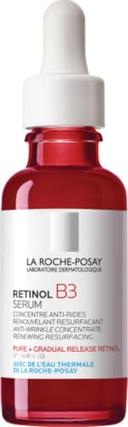
Dryness and reactivity dominating: La Roche-Posay Pure Retinol, which pairs its retinol with niacinamide and hyaluronic acid and is fragrance-free, or the sensitive-skin roundup if it is still too much.
Jaw, neck and chest: the Naturium retinal. Already tolerant and want a closer molecule: The Ordinary Retinal 0.2%. Starting from nothing on a budget: The Ordinary Retinol 0.2%.
What we left out, and what to read instead
Anything hormonal. We write about topicals. Whether a prescription treatment is appropriate for breakouts or for anything else in this period is a conversation with a clinician, not a product recommendation, and we are not going to blur the two.
Rich anti-aging night creams, as a category, because the congested half of this problem is the reason people stop using them. They are ranked on our creams roundup for readers whose skin is uniformly dry.
The post-menopausal case, which is a different page: retinol for menopausal skin covers the collagen curve after menopause and ranks for a drier, more uniformly reactive barrier. If your cycles have stopped, start there instead of here.