The trade you cannot avoid under $25
It is this: a published dose or a buffered base, not both.
The only brands in this band that print a retinoid percentage are The Ordinary (0.2%, 0.5% and 1% retinol, plus a 0.2% retinal) and SKIN1004 (0.2% retinol). Those formulas are deliberately plain — the squalane retinols in particular are pure retinol in an anhydrous oil with no niacinamide, no ceramides and nothing soothing in the bottle. Everything that cushions the retinoid has to be something else you own.
The brands that do the cushioning for you — CeraVe with three ceramides plus niacinamide and hyaluronic acid, Naturium with encapsulation plus bakuchiol, RoC with a fragrance-free silicone-and-ceramide capsule, Neutrogena with hyaluronic acid — publish no percentage at all. Nothing requires them to: the federal rule orders cosmetic ingredient lists by predominance only above one percent, and every cosmetic retinoid sits below that line, so even a complete list cannot yield a dose. Position proves presence, never amount.
Which side of that trade is right depends on one question, and it is not your budget. Do you intend to escalate? If you want to move deliberately up a ladder over a year, you need a number to move from, and you should buy a stated dose and bring your own moisturizer. If you want one bottle that behaves itself and you have no plans to change anything, take the buffered formula and accept that you will never know the dose. Our step-up guide is written for the first group and our sensitive-skin roundup for the second.
Six bases, and what each one is for
Anhydrous oil (squalane) — The Ordinary’s retinols
Pure retinol dispersed in squalane, no water phase. The advantage is stability: an anhydrous formula sidesteps the pH and packaging problems a water-based one creates, which matters more than it sounds given that a validated study of sixteen retinoid derivatives across twelve commercial cosmetics measured losses of 0% to 80% over six months at 25 °C and 40% to 100% at 40 °C, with light degradation worse than heat. The disadvantage is that squalane cushions a little and buffers nothing, and the finish can feel heavy layered over other oils. Three stated strengths — 0.2%, 0.5%, 1% — which is what makes this the ladder format. Our The Ordinary range page lays the whole ladder out.
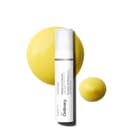
Water-based emulsion — the Retinal 0.2%
Lighter than the squalane serums and carrying the better molecule. One honest note we record on every page that ranks it: the brand’s own US product page publishes a free-from list for this product — alcohol-free, oil-free, silicone-free, vegan, cruelty-free, water-free “No”, pH 6.0–7.0 — and fragrance-free is not on it, and no claim appears anywhere else on the page. So our spec table reads “Not published” for its fragrance status rather than inheriting the fragrance-free claim the squalane rungs do carry. The other caveat is size: 15 ml, half what most serums here give you, which makes it a face-only product.
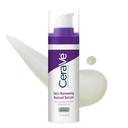
Ceramide-buffered fluid — CeraVe Skin Renewing
The best-behaved formula in the band. Retinol with niacinamide, hyaluronic acid and CeraVe’s three-ceramide complex in a fluid base, and the brand states the fragrance position outright: its own US product page carries the label claim “Free of Added Fragrance” with the stated reason “To avoid fragrance irritation”, and the published ingredient list contains no fragrance, parfum or essential oil. Niacinamide has its own published record on barrier function and on tone, separately from the retinoid, so the supporting cast is doing real work rather than decorating the label. The cost is total opacity on dose. Our CeraVe range page also explains how to tell this serum apart from the Resurfacing one, which is built for a different job.
Encapsulated gel-cream — Naturium Retinol Complex
Encapsulated retinol with bakuchiol, fragrance-free, pitched at people who react to things. Encapsulation is a real attempt at the stability-and-irritation problem above, and it is worth being precise that it describes deliveryrather than dose — it cannot be compared across brands because none of them publishes the carrier chemistry. Bakuchiol belongs at the distance its evidence supports: one reasonable head-to-head found it comparable to retinol and better tolerated, against retinol’s much larger record, so treat it as tolerance support and not a second active. Our bakuchiol comparison covers it properly.
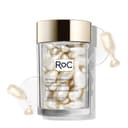
Sealed single dose — RoC Retinol Correxion capsules
The only product in the band whose complete formula the brand publishes: eight ingredients — cyclopentasiloxane, ethylhexyl cocoate, dimethiconol, soybean oil, retinol, dimethylmethoxy chromanol, ceramide NP, phenoxyethanol — with no water, and the explicit statement “FORMULATED WITHOUT FRAGRANCE”. The sealed dose answers the stability problem structurally rather than chemically, and being pre-measured removes the commonest beginner error, which is using far too much. Two honest costs: thirty capsules is a month at most, so the running cost is the worst on the page per night of use; and the brand’s “97% had visibly smoother skin in 1 night” claim carries no sample size, no design and no publication, and the Amazon listing quotes the same study with different figures. An overnight change describes the silicone finish, not retinoid activity. Its full review takes that apart.
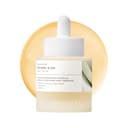
Centella ampoule — SKIN1004 Retinol 0.2% Boosting Shot
The one product here that does both halves — a stated 0.2% retinol and a supporting cast, in this case centella asiatica, with retinal alongside the retinol. That makes it the most interesting bottle in the band and the reason it is on the page at all. The reason it is not higher: it publishes the retinol figure but not the retinal one, so you know part of the dose and not all of it, and the ampoule format is a 30 ml dropper rather than anything protective. Our Korean retinol roundup explains why this shelf publishes percentages far more often than the US drugstore shelf does.
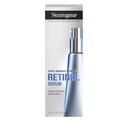
Drugstore serum — Neutrogena Rapid Wrinkle Repair
Retinol with hyaluronic acid, 1 fl oz, from the biggest retinol line in any US drugstore. Worth knowing exactly what the hyaluronic acid does: it is a humectant, so it holds water in the stratum corneum and addresses the feelof retinoid dryness. That is useful and it is not the same job as replacing a barrier lipid, which is what a ceramide does. The cons are the brand’s: no percentage, and no fragrance claim in either direction on this particular listing, even though two other products in the same Neutrogena line do publish one. Our Neutrogena range page is built on that inconsistency.
The criteria, in order
- A live price strictly under $25at our last dated check. Nothing is included on a “usually about” basis.
- A published dose, or a base that earns its absence. Every pick does one or the other, and the card says which.
- One pick per base. Seven near-identical squalane bottles would not help anyone choose.
- Molecule before percentage. A stated 0.2% retinal is a stronger proposition than a stated 0.2% retinol because of the conversion step, not the digit.
- Published fragrance status, flagged either way, because the reaction is frequently delayed by days and gets blamed on the retinoid.
- Cost per night over ten months, not cost per bottle — which is where the capsules lose ground and the squalane serums win outright.
Which one, by situation
First retinoid ever: the budget pick, two nights a week, moisturizer over the top. Our beginner roundup covers the ramp, which matters far more than which of these bottles you buy.
Already comfortable on a retinol and want more effect for the same money: the Retinal 0.2%. Sideways to a closer molecule beats up to a bigger number; our retinol vs retinal page explains why.
Skin that reacts to everything: the CeraVe fluid, or the Naturium if you would rather have bakuchiol than niacinamide.
You travel, or you have wrecked a bottle by leaving it on a windowsill: the RoC capsules. You want a figure AND a supporting ingredient: the SKIN1004 ampoule. You want it from a brand your pharmacy stocks: the Neutrogena serum.
You want a stated 0.5% or 1%: both exist in this band, from The Ordinary, and both are on our high-strength roundupwith the warning they deserve — a stated 1% is the right buy only once 0.5% is uneventful nightly.
What $25 does not buy, and what it does not matter for
It does not buy an airless pump, a published percentage from any drugstore brand, or a clinical trial. On that last point, be clear that no cosmetic retinol on this site has a trial of its own at any price. The evidence the whole category borrows from is prescription tretinoin: a double-blind study showing epidermal hyperplasia, compaction of the stratum corneum and new collagen fibrils in the papillary dermis, with the changes peaking at around ten months; and a controlled trial in which collagen I formation rose 80% on daily tretinoin against a 14% fall on vehicle. A $9 serum inherits exactly as much of that as a $65 one — the mechanism, and the requirement to keep going.
Which is the argument for this band rather than against it. The published improvement curve runs for most of a year, so the single best predictor of whether a retinoid does anything for you is whether the bottle is still in your bathroom in month nine. A serum that costs less than lunch is easier to keep re-buying than one that costs sixty-five dollars, and there is one more thing it is easier to do: throw away. Retinol degrades once opened, so finishing a cheap 30 ml bottle on schedule beats rationing an expensive one for a year.
What we left out
Everything over the line— La Roche-Posay’s pharmacy serum, L’Oreal’s stated 0.3%, Naturium’s stated 0.10% retinal and Paula’s Choice’s stated 1% are all better products than parts of this page and none of them fits the band. They are ranked on our under-$50 page and our full serum roundup.
Duplicate bases.The Ordinary’s 0.5% and 1% rungs and CeraVe’s Resurfacing serum all qualify on price and are deliberately not listed separately — they share a base with a pick that is already here, and the point of this page is one answer per base.
Non-serum formats. Creams, eye creams and body lotions under the same ceiling are on our under-$25 page, which runs one pick per format rather than one per base.
Products with no live offer. We will not rank a product the daily check cannot price, which is why one serum in our registry is absent from this page despite its usual price sitting inside the band.