RoC Retinol Correxion Night Serum Capsules Review
Thirty sealed doses of retinol in a base with no water and no fragrance, from the drugstore brand that has been selling retinol longer than almost anyone. The format solves a real problem. The ingredient list is unusually honest. The strength is still a secret, and the one-night claim is not about the retinol at all.
How this is funded: we earn a commission if you buy through our links, at no extra cost to you. It never changes which product we recommend, and we’ll tell you when we’d skip one. Full disclosure.
The affordable way to buy retinol in single-dose capsules. You get the same airtight, pre-measured logic as the luxury versions at drugstore money, from the brand with the longest retinol track record on the shelf — with the same undisclosed strength as the rest of RoC's range.
Strengths
- Airtight single doses at a drugstore price
- Pre-measured, which stops the most common beginner mistake of using too much
- RoC has been formulating retinol longer than almost anyone on the shelf
Trade-offs
- Retinol strength is not published
- 30 capsules is a month at most, so the running cost adds up
| Key active | Retinol |
|---|---|
| Stated concentration | Not published |
| Format | Single-dose capsule serum |
| Fragrance-free | Yes |
| Best for | A measured nightly dose without a premium price |
Formulation note. Retinol sealed in single-use capsules, so the product is not sitting in a part-used bottle oxidizing between uses. That is a packaging advantage, not a strength claim — the concentration is undisclosed. The published ingredient list is eight items with no water and no fragrance: a silicone-and-oil base, retinol, an antioxidant, ceramide NP and a preservative. 0.35 oz total across 30 capsules per the listing.
Ingredients and claims read from the product listing, on September 19, 2026. “Not published” means the brand does not state that figure.
Most of what this site has to say about retinol packaging is a complaint. Light degrades retinol; most bottles let some in. Air oxidizes it; most bottles admit a little every time they are opened. Fingers introduce microorganisms; jars invite fingers. A sealed single-dose capsule answers all three at once, and until recently the format was priced as a luxury. RoC’s version is the drugstore one — the same idea, at a fraction of the cost per night of the premium capsules it shares a shelf with.
That makes it an unusually easy product to like, and an unusually easy one to over-praise. This review tries to do neither. The format is genuinely good. The ingredient list is short and, for a drugstore retinol, unusually honest. But the strength is unpublished, the headline clinical claim is not about the retinol, and the running cost is real. All of that belongs in the same paragraph as the praise.
One product, two names
Worth clearing up first, because it confuses buyers. Amazon lists this as the Retinol Correxion Anti-Aging Wrinkle Night Serum Capsules. RoC’s own site sells the identical product as the Retinol Correxion Line Smoothing Night Serum Capsules. Same count, same capsule, same eight-ingredient list. If you have seen both names and assumed there were two products, there are not — there is a retailer name and a brand name. (RoC also lists a “mini” version on its own site; the Amazon listing this page links to is the standard thirty.)
What is actually in it
RoC publishes the full ingredient list on its product page, and it is eight items long: cyclopentasiloxane, ethylhexyl cocoate, dimethiconol, soybean oil, retinol, dimethylmethoxy chromanol, ceramide NP and phenoxyethanol. That is a short list even by the standards of a serum, and it tells you three things.
First, there is no water in it. The base is silicones and oil — two silicones, an ester, a plant oil — which is why RoC can describe the serum as something that “dries silky.” A water-free formula has no water phase to keep stable, so it needs no emulsifier to hold oil and water together, which is part of why the list is so short. Second, the antioxidant RoC advertises as “bioderived” with “2X effectiveness of Vitamin E” is dimethylmethoxy chromanol, one ingredient, whose job is to protect the retinol from oxidation inside the capsule. Third, there is one ceramide, ceramide NP, which is the barrier-support half of the “retinol and ceramides” the marketing leads with.
There is no fragrance in the list, and both the listing and the brand page say so outright. That deserves emphasis because it is the exception in RoC’s retinol range: the Retinol Correxion night cream and the under-eye cream both contain fragrance, and on both pages we list that as a real caveat, because the American Academy of Dermatology names fragrance among the most common causes of allergic contact dermatitis. If you like RoC and dislike scent, the capsules are the RoC retinol to buy.
What the list does not tell you is how much retinol is in there. RoC calls it “Clinical Retinol,” describes it as “concentrated,” and mentions “30+ years of expertise & 26 patents.” None of those is a number. Our spec table prints Not published, and our strength guide explains why that matters for every decision you make afterwards — you cannot place this product on the ladder, and you cannot know what you are stepping up from when you eventually move on.
The stability case, with the actual numbers
The reason a sealed capsule is worth paying for is not marketing; it is a measured problem. A 2021 study in the Journal of Cosmetic Dermatology put sixteen retinoid derivatives from twelve commercial cosmetics through six months of stability testing. The products lost between 0% and 80% of their retinoid at room temperature over those six months, and between 40% and 100% at 40 °C. Light did more damage than heat. And the authors found the instability was formulation-dependent and, in some products, associated with a lower retinoid content than the label declared.
That is the shelf life of a part-used bottle, and it is why our shelf-life guide ranks single-dose capsules at the top of the packaging hierarchy. A capsule you open on night ninety has never met light or air; a bottle you opened on night one has met both eighty-nine times. The FDA’s own cosmetic shelf-life guidance adds the third route — fingers dipped into a product introduce microorganisms the preservative then has to control — and a single-use capsule closes that one too. None of this makes the retinol stronger. It makes the dose on the last night the same as the dose on the first, which is the most a package can do.
The obvious caveat: the study above did not test this product. We are citing it for the size of the problem the format solves, not as evidence that RoC’s capsule is stable. A sealed capsule protects against the exposure routes the study identified; whether the formula inside holds its declared content is something only RoC knows, and RoC has not declared a content.
What the one-night claim is really describing
The listing says that “in a clinical study, 97% had smoother skin in 1 night.” RoC’s own site uses the same 97% twice — once as “visibly smoother skin” and once as “visibly reduced lines & wrinkles,” both in one night — then 100% with “visibly firmer skin” at four weeks. The two versions of the one-week hydration figure differ by a point (63% on Amazon, 64% on the brand site), and the firmness figure changes shape entirely between them (“visibly firmer by 30%” versus “100% had visibly firmer skin”). Neither version gives a sample size, a study design, a comparator or a publication.
Here is the honest way to read it. Retinol does not remodel skin overnight. The published retinoid record measures change over weeks and months — the long-term tretinoin work found improvement peaking at around ten months — and the AAD frames over-the-counter retinol as the gentler, slower member of that family. What a silicone-and-oil serum can do in one night is leave a smooth, silky film on the surface, which is exactly what “dries silky” describes. So the one-night number is best understood as a claim about the finish, made by a serum whose base is designed to produce that finish. The four-week numbers are the earliest point at which anything the retinol is doing could plausibly show. Treat both as brand claims, because that is what they are.
The dose, and the arithmetic
The listing gives the total as 0.35 oz for thirty capsules, which works out to roughly a third of a milliliter each. That is a small amount and it is meant to be: RoC’s directions say one capsule covers the cleansed face and neck. If you have read our how-much guide, you know a pea-sized amount is the usual whole-face dose and that more product buys irritation rather than results. A capsule makes the over-application mistake impossible, which is the second real benefit of the format after stability, and the one that matters most to a beginner.
The cost follows from the count. Thirty capsules is thirty applications: a month at nightly use. But the brand’s own instruction is to start every other night and build up, so a first box lasts a new user six to eight weeks, and a cautious user on two nights a week stretches it past three months. Per ounce, a capsule product is expensive next to a bottle; per night, at the drugstore price this one sells for, it is not. Run the comparison against the live price on this page rather than against a number we might have written months ago, and compare it to a bottle you would realistically finish in the same period — because a bottle you take a year to finish is, per the study above, not the bottle you bought.
Physical capsules are not molecular encapsulation
The listing uses the word “encapsulated,” and it is worth being precise about which kind. This is a physically encapsulated dose: a sealed shell holding one night’s serum. Molecular encapsulation — the retinol itself wrapped in a carrier that releases it gradually on the skin, as in CeraVe’s resurfacing serum — is a delivery and tolerability mechanism, not a packaging one. RoC’s ingredient list shows no carrier system; the encapsulation here is the shell. Both approaches are legitimate and they solve different problems; our encapsulated roundup separates the two categories and ranks these capsules as the best single-dose pick.
The waste question
Thirty shells a month is the trade the format asks for, and we would rather name it than skip it. RoC’s answer is that each capsule is “vegetal-based” and “100% biodegradable.” We record that as a brand claim we have not verified, and note that biodegradable-in-principle and compostable-in-your-bin are not the same thing. It is a better answer than the premium capsules give, and it is still a single-use format. If packaging waste is a deciding factor, an airless pump sits one rung below capsules in the stability hierarchy and produces one container a quarter instead of ninety shells.
Capsules or cream: which RoC to buy
This is the comparison most people searching for the capsules are actually making, and it comes down to base and fragrance rather than strength — RoC publishes neither. The night cream delivers its retinol in a rich moisturizing base, which is a genuine advantage for dry, mature skin that finds serums tightening and wants one step rather than two. It contains fragrance. The capsules deliver a lightweight silicone-and-oil serum that most people will want a moisturizer over, in a sealed dose, without fragrance.
So: dry or mature skin, one-step routine, unbothered by scent — the cream. Fragrance averse, reactive, prone to using too much, or simply irritated by the idea of a jar oxidizing on a shelf — the capsules. If you cannot decide, the capsules are the safer first purchase, because everything that can go wrong with them is smaller.
Who it suits
Beginners, more than almost any other product on this site. The two mistakes that end most first attempts at retinol are using too much and using a product that has quietly degraded, and a sealed pre-measured capsule removes both. Our beginner roundup weights stated strength heavily, which is why this does not lead it — but for someone who will never read a percentage anyway, the format does more to protect them than the number would.
Anyone who wants a fragrance-free RoC. Anyone who travels with skincare and worries about heat and leaking bottles. Anyone who wants a routine with no decisions in it. And, as our under-$25 gift guide says, anyone buying retinol for someone else: a sealed, measured, fragrance-free dose is about the hardest retinol to misuse, and a jar of capsules looks like a present in a way a drugstore tube does not.
Who should skip it
Anyone who wants a published strength. It is the biggest thing missing here, and no amount of packaging cleverness supplies it. A stated 0.2% or 0.5% in a plain bottle teaches you more about your own tolerance than an undisclosed dose in a perfect capsule, which is why the third alternative below is The Ordinary.
Anyone with dry skin who wants the moisturizer built in — that reader is better served by RoC’s own cream. Anyone treating a large area: a third of a milliliter is a face and a neck, not a chest or a pair of arms, and our body lotion roundup is where that job belongs. And anyone for whom a nightly single-use shell is a dealbreaker regardless of what it is made of.
How to use it
RoC’s directions are close to what we would write anyway. At night, on cleansed and fully dry skin, twist one capsule open and smooth the serum over the face and neck. Start every other night and build toward nightly only as your skin stays calm; our frequency guide covers the ramp in more detail, and a pre-measured dose is not a reason to skip it when you cannot see the strength. Discard the shell — it will not keep.
Moisturizer over the top most nights, because this is a serum rather than a cream and the ceramide alone is not a moisturizer. No acids or strong vitamin C in the same evening while you adjust, per the layering guide. Store the jar sealed, cool and dry, as the brand says. And broad-spectrum SPF 30 or higher every morning, which RoC prints on its own page and which no packaging format removes the need for.
The verdict
The best-protected retinol format there is, at a drugstore price, in a formula short enough to read in one breath and honest enough to skip the fragrance. For a beginner, a fragrance-averse RoC loyalist, or anyone giving retinol as a gift, it is one of the easiest recommendations on the site.
The reservations are the ones RoC has had for years: the strength is not published, and the efficacy claims are brand claims with no study behind them that you can read — and the one-night figure in particular describes the silicone finish, not the retinol. Buy it for the format and the formula, with a clear view of what the missing number costs you, and plan for a moisturizer over the top.
General guidance, not medical advice. Retinol Room is written by an enthusiast, not a dermatologist. For a diagnosis, a reaction, or a prescription active like tretinoin, see a qualified professional. Introduce any new active slowly and patch-test first.
If it’s not the one, consider these
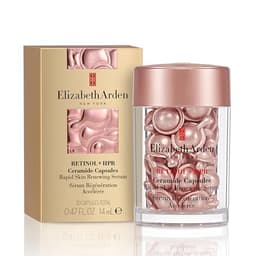
Elizabeth Arden Retinol + HPR Ceramide Capsules Skin Renewing Serum (30 ct)
The premium capsule: retinol plus HPR plus ceramides in the same sealed single-dose format, at a much higher cost per night and with two undisclosed strengths instead of one.
Read the full review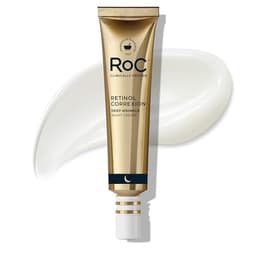
RoC Retinol Correxion Deep Wrinkle Night Cream
RoC's own night cream — the same brand's retinol in a rich moisturizing base for dry, mature skin. Fragranced, which is the reason to choose the capsules over it.
Read the full review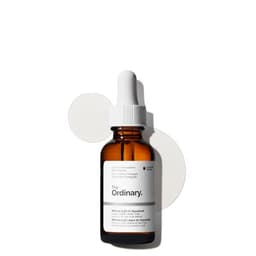
The Ordinary Retinol 0.5% in Squalane
If the missing number bothers you: a stated 0.5% in a fragrance-free squalane base for less than the capsules, in a plain dropper bottle you will need to keep dark and closed.
$9.30 · View on AmazonRead the full reviewPrice as of September 19, 2026. #ad How we’re funded
Frequently asked questions
What percentage of retinol is in RoC Retinol Correxion capsules?
RoC does not publish it, so our spec table prints 'Not published' and we will not fill it in from a guess. The brand calls the active 'Clinical Retinol' and describes it as 'concentrated', but neither phrase is a number. This is consistent across RoC's whole retinol range — the night cream and the eye cream do not print a strength either — and it is the single biggest limitation of the product: you cannot place it on the strength ladder or compare it on potency with anything that does state a figure.
Are RoC's capsules the same as the 'Line Smoothing Night Serum Capsules'?
Yes. Amazon lists the product as 'RoC Retinol Correxion Anti-Aging Wrinkle Night Serum Capsules, 30 count'; RoC's own site calls the same product 'RETINOL CORREXION Line Smoothing Night Serum Capsules'. The ingredient list, the count and the capsule are the same — it is one product with a retailer name and a brand name.
Is it fragrance-free?
Yes, and this is the clearest difference between the capsules and the rest of RoC's retinol range. The Amazon listing states 'Fragrance-free', the brand page states 'Formulated without fragrance', and the published eight-ingredient list contains no fragrance, parfum or essential oil. RoC's Retinol Correxion night cream and its under-eye cream both contain fragrance, so if you like the brand but not the scent, this is the RoC retinol to buy.
RoC capsules vs RoC cream — which should I buy?
Buy the cream if your skin is dry or mature, you want treatment and moisturizer in one step, and fragrance does not bother you. Buy the capsules if you want a fragrance-free formula, if a half-used jar oxidizing on a shelf bothers you, or if you tend to use too much — a capsule makes over-application impossible. The capsules are a lightweight silicone-and-oil serum rather than a cream, so most people will want a moisturizer over them; the cream is the moisturizer.
Does the 'smoother skin in one night' claim mean the retinol works overnight?
No, and RoC does not quite say that either. Retinol changes skin over weeks and months; the published retinoid record measures improvement at those timescales, not overnight. What a silicone-and-oil serum can genuinely do in one night is leave a smooth, silky-feeling film — the listing itself says the serum 'dries silky'. Read the one-night figure as a statement about the finish, and the four-week figures as the earliest point anything retinol-related could plausibly be showing. Neither claim comes with a sample size or a published study.
How long does a box last?
Thirty capsules is thirty applications. At nightly use that is one month, which is how RoC describes it. But RoC's own directions say to start every other night and build up, so a first box realistically lasts six to eight weeks for a new user — which also makes the cost per night lower while you are ramping. Compare the live price on this page against a bottle you would use for three months before deciding whether the format is worth it to you.
Can I use half a capsule?
You can twist one open and use part of it, and plenty of people do while building tolerance. What you cannot do is save the rest for tomorrow — once the seal is broken the contents are exposed to air and light like any other retinol, which is the whole thing the capsule was protecting against. Use the remainder on the neck or the backs of the hands the same night.
Are the capsules plastic?
RoC states that each capsule is 'vegetal-based' and '100% biodegradable'. That is the brand's claim; we have not verified it and it does not change the fact that this is a single-use format that generates a shell per night. If packaging waste is a deciding factor for you, a tube or an airless pump gets you most of the stability benefit with none of the shells.
Sources
- RoC Skincare — RETINOL CORREXION Line Smoothing Night Serum Capsules (brand product page) — RoC's own page for the product Amazon lists as 'Retinol Correxion Anti-Aging Wrinkle Night Serum Capsules'. Publishes the full ingredient list — 'Cyclopentasiloxane, Ethylhexyl Cocoate, Dimethiconol, Glycine Soja (Soybean) Oil, Retinol, Dimethylmethoxy Chromanol, Ceramide NP, Phenoxyethanol' — and states 'FORMULATED WITHOUT FRAGRANCE' and 'EACH VEGETAL-BASED CAPSULE IS 100% BIODEGRADABLE'. Directions: 'Gently twist to open the capsule. Smooth serum over cleansed face and neck at night', 'Begin applying this product every other night and then gradually increase frequency of use to every night', 'Always apply a sunscreen of SPF 30 or higher in the AM while using this product', and store 'sealed in their container in a cool, dry place'. Its efficacy claims ('97% had visibly smoother skin in 1 night', '97% had visibly reduced lines & wrinkles' in 1 night, 'Skin was 64% more hydrated' in 1 week, '100% had visibly firmer skin' in 4 weeks, '100% of testers had 0% irritation') carry no sample size, study design or publication; the Amazon listing's bullet quotes the same study as '97% had smoother skin in 1 night', '63% more hydrated in 1 week' and 'visibly firmer by 30% after 4 weeks'. No retinol percentage is stated anywhere on the page. Cited for what the brand publishes about its own formula, not as evidence of efficacy (accessed September 19, 2026)
- Temova Rakuša Ž, Škufca P, Kristl A, Roškar R — Retinoid stability and degradation kinetics in commercial cosmetic products (J Cosmet Dermatol, 2021) — Validated HPLC-UV study of 16 retinoid derivatives (retinol, retinyl palmitate, beta-carotene and hydroxypinacolone retinoate) in 12 commercial cosmetics over 6 months of long-term and accelerated stability testing plus a one-week photostability study. Retinoid degradation followed first-order kinetics; the products showed a 0%-80% decline after 6 months at 25 °C and a 40%-100% decline at 40 °C; 'light degradation was more pronounced than temperature-induced degradation'; instabilities were 'formulation-dependent and associated with lower contents than declared in some cosmetics'. Cited for the size of the stability problem a sealed single-dose format is built to solve — the study did not test this product (accessed September 19, 2026)
- U.S. FDA — Shelf Life and Expiration Dating of Cosmetics — FDA states no U.S. law requires cosmetics to carry an expiration date, that drugs (including sunscreens and acne treatments) must, and that heat and dipping fingers into a product shorten its usable life (accessed August 19, 2026)
- American Academy of Dermatology — Retinoid or retinol? — AAD on the difference between prescription retinoids and OTC retinol (accessed July 17, 2026)
- Human Skin Aging and the Anti-Aging Properties of Retinol (PubMed) — Review of topical retinol's effect on collagen and photoaging (accessed July 17, 2026)
- Voorhees JJ — Clinical effects of long-term therapy with topical tretinoin and cellular mode of action (J Int Med Res, 1990) — Double-blind, placebo-controlled study: 0.1% topical tretinoin reduced the effects of photoageing maximally after 10 months, with no further improvement between 10 and 22 months. Histologically it induced 'epidermal hyperplasia, compaction of the stratum corneum and the deposition of ultrastructurally visible collagen fibrils in the papillary dermis', reduced the number and activity of melanocytes, and significantly increased mitoses (accessed September 18, 2026)
- American Academy of Dermatology — Eczema types: Contact dermatitis causes — AAD names fragrance among the most common causes of allergic contact dermatitis, and notes the rash can take hours or days to appear (accessed August 19, 2026)
Keep reading
RoC Retinol Correxion night cream, reviewed
The other half of the capsules-vs-cream question — who the fragranced cream base genuinely suits.
Read the reviewElizabeth Arden Retinol + HPR Capsules, reviewed
The premium single-dose capsule, and what the extra money buys beyond the format.
Read the reviewBest encapsulated retinol
Two different things are sold under one word — a sealed capsule and an encapsulated molecule — and this is the first kind.
See the picksDoes retinol expire?
The stability problem the capsule is built to solve, and the full packaging hierarchy from capsule down to jar.
Read the guideHow much retinol to use
Why a pre-measured dose matters, and what a third of a milliliter looks like next to the usual pea.
Read the guideRetinol gifts under $25
Where these capsules are the top pick — and why a sealed, measured dose makes an unusually safe present.
See the picks