Olay Retinol Body Lotion Review
Seventeen fluid ounces of fast-absorbing retinol lotion at drugstore pricing, and the least-documented product in this category. Olay publishes no ingredient list for it, no retinol percentage for it, and the only figure on the whole Retinol24 line page is a comparison against another Olay product. Here is what that leaves you able to judge — and why volume is still a real argument.
How this is funded: we earn a commission if you buy through our links, at no extra cost to you. It never changes which product we recommend, and we’ll tell you when we’d skip one. Full disclosure.
Effectively a everyday body moisturizer with retinol and Olay's vitamin B3 complex folded in, in a 17 oz bottle. Judge it as a moisturizer that treats a little rather than a treatment that moisturizes — which, for most people who just want smoother arms without a new routine, is the honest and useful framing.
Strengths
- Vitamin B3 (niacinamide) complex alongside the retinol
- 17 oz at a drugstore price — genuinely generous
- Fast-absorbing lotion texture that works as a daily moisturizer
Trade-offs
- Lightest treatment intent of this list — a moisturizer first
- Retinol strength is not published
| Key active | Retinol + vitamin B3 complex |
|---|---|
| Stated concentration | Not published |
| Format | Fast-absorbing body lotion |
| Fragrance-free | Not published |
| Best for | Everyday moisturizing with a light retinol benefit |
Formulation note. Retinol with Olay's vitamin B3 (niacinamide) complex in a 17 oz fast-absorbing body lotion, per the listing. The niacinamide is the reason it stays comfortable daily; the retinol dose is undisclosed and, given the positioning, modest.
Ingredients and claims read from the product listing, on October 31, 2026. “Not published” means the brand does not state that figure.
What Olay actually tells you
Every other review on this site starts with a formula. This one cannot, because there is not one to start with. Olay publishes no ingredient list for this product on its own website, and the Retinol24 line page carries no concentration for any product in the range. The entire set of actives we can attribute to this lotion comes from one place — the listing title — and it reads, in full:
Olay Hand & Body Lotion for Women, Smoothing with Retinol24, 17 fl oz | 24HR Moisture | Lightweight & Fast-Absorbing Repair, with Vitamin B3 for Soft, Smooth Skin | Free of Parabens & Phthalates
That is the spec sheet. A retinol, Olay’s Vitamin B3, 17 fluid ounces, a claim about parabens and phthalates, and two texture claims. We re-pulled that record on October 31, 2026 and the product returned In Stock with a live price, so it is current — it is simply undocumented.
Note what is absent as carefully as what is there. No retinol percentage. No fragrance-free claim, in a title that goes out of its way to name two other things it is free of. And no ingredient list to check either against.
The one number on the line page is not a dose
This is the detail worth carrying away, because it tells you the omission is a choice rather than an oversight. Olay’s own Retinol24 collection page names the active as “Pro-Retinol” and lists “Pro-retinol, triple collagen peptide, carnosine” among key ingredients, with one line of description: “Pro Retinol visibly corrects wrinkles and smooths textures.” It does not define the blend. The single figure anywhere on the page belongs to the MAX moisturizer — “Pro Retinol 19% more”, footnoted “vs base Retinol 24.”
So Olay is willing to quantify one of its products against another to one decimal of marketing precision, while publishing the dose of neither. 19% more than an undisclosed amount is not information. It is the shape of information.
This matters beyond pedantry. The reason this site prints “Not published” in a spec table instead of an estimate is that a percentage is the only thing that lets you step up deliberately or compare two products honestly — and the federal rule on cosmetic ingredient lists orders ingredients by predominance only above one percent, which every cosmetic retinoid sits below. Even a full list would not have given us a dose here. The absence of the list means we cannot even tell you where the retinol sits relative to the water.
What the Vitamin B3 is doing
The one named supporting active is the most defensible thing on the label. Niacinamide has a genuine published record in dermatology for barrier function, tone and texture, and in a retinoid product its specific job is tolerability — it is the reason a daily-use lotion with a retinoid in it stays comfortable on large areas of skin. Olay has built its retinol positioning around that pairing across the line, and on a body product applied to arms and legs most nights, it is the sensible choice.
What we cannot tell you is how much of it there is, for the same reason as the retinol.
Volume is the real argument, and it is a better one than it sounds
Seventeen fluid ounces — roughly 500 ml — against the 8 oz that is standard in this category, at drugstore pricing. That sounds like a shopping detail rather than a formulation one. It is actually the thing most likely to decide whether a body retinoid does anything for you.
Face retinoids fail from over-application. Body retinoids fail from the opposite: the surface area is enormous and people ration. The fingertip-unit figures make the scale concrete — an arm and forearm take about 3.3 units, a leg and thigh about 5.8, the front of the trunk about 6.7, against 2.5 units for the entire face and neck. Covering both arms and both legs is an order of magnitude more product than a facial routine, several nights a week, for the ten months or so that any retinoid needs before it is fair to judge it.
A small expensive bottle in that scenario gets used on the worst patch and nowhere else, which is how people conclude body retinol does not work. A 17 oz bottle at this price gets used the way the published studies applied it. That is a real argument, and it is the honest reason this product earns its place on our body-lotion roundup despite being the least-documented thing on it.
What a retinoid does on body skin
Worth separating from the marketing, because the body category oversells harder than the face one. The supporting record is real but modest: a cosmetic retinol applied to aged arm skin produced measurable improvement, and topical tretinoin on forearms did likewise. Thin, crepey texture on arms and legs is a reasonable target. The biopsy-level collagen work — formation around 56% lower in severely photodamaged skin, rising roughly 80% on ten to twelve months of daily tretinoin — is prescription-dose evidence for the direction of effect, not a promise about an undisclosed cosmetic dose in a lotion.
What it will not do is tighten anything. The AAD is explicit that a cream or lotion cannot penetrate deeply enough to lift sagging skin and that firming results are subtle at best. If a fold stays lifted when you pinch it, that is laxity, and no body lotion changes it. Established stretch marks are scar tissue and are likewise out of reach.
The “Hand” in Hand & Body Lotion
Easy to skim past in the title, and it is the one claim on the label with the best supporting evidence behind it. Hands are where a retinoid has the most to work with on the body: they get more cumulative daylight than anywhere except the face, the skin on the back of the hand is thin, and the visible problems there — crepiness, sun spots, a dull or mottled tone — are exactly photodamage. The published record is specific rather than general: topical tretinoin has been studied on liver spots, and a tretinoin plus mequinol combination on solar lentigines, with measurable improvement in both.
The practical problem with treating hands is not the formula. It is that you wash them. A retinoid applied to the back of the hand at night is a reasonable intervention; the same product applied in the morning is down the sink by mid-morning. So the honest way to use this on hands is as the last thing you do before bed, and to accept that the area needs a separate daytime routine — a plain moisturizer after washing, and sunscreen, which on hands is the step that does most of the work. The AAD’s own hand-care guidance is blunt that sun protection is what keeps hands looking younger.
A dedicated hand treatment will be more occlusive and better suited to overnight work. But for a product you are already applying to your arms, extending it across the backs of your hands costs nothing and targets the area most likely to show a result. Our page on retinol for hands covers the format question and the washing problem properly.
How to actually run it
- Two or three nights a week to start, on clean dry skin, on the areas you actually care about. Body skin is not uniformly tolerant — the inner arm and the chest react more than a shin.
- Use enough. This is the one instruction that matters most here and the one the bottle size exists to permit. Under-application is the failure mode.
- Not straight after shaving, and not on broken or freshly waxed skin. Give it a day.
- Sunscreen on anything you expose. A retinoid raises sun sensitivity while skin adjusts, and arms, hands and chest are the areas that get incidental daylight all year.
- Judge it at ten months, not at ten days. Texture first, tone later, and nothing dramatic at any point.
One storage note. The validated stability work on retinoid derivatives in commercial cosmetics found losses of 0% to 80% over six months at 25 °C and 40% to 100% at 40 °C, with light worse than heat. A large opaque bottle you will take most of a year to finish is better placed in a bedroom drawer than on a sunny bathroom windowsill. No brand here publishes its own stability data, this one included.
Who should buy it, and who should not
Buy it if you want your daily body lotion to also contain a retinoid, you have a lot of skin to cover, and you would rather apply enough of a simple product than ration a sophisticated one. It is the cheapest honest way into the category and the easiest one to actually keep doing.
Do not buy it if you shave the area you are treating, react to fragranced products, or have any history of contact dermatitis — not because this lotion is known to be fragranced, but because nobody will tell you either way, and there is a product in the same category whose complete published list settles the question. Do not buy it if you want a treatment-strength body retinoid; the formula behind the retinol is thinner than its competitors’. And do not buy it expecting a number, because this brand does not print one.
The verdict
A good purchase and a poor disclosure, and it is worth being clear that those are two separate judgments. Judged as a treatment it is the weakest body retinol we cover: no published formula, no dose, no fragrance claim, and a supporting cast of one named active. Judged as what it is — a large, cheap, pleasant daily lotion that happens to contain a retinoid and a well-chosen buffer — it is genuinely useful, and the volume solves the single biggest practical problem in body retinoids.
So: buy it as a moisturizer that treats a little, not as a treatment that moisturizes. If you want to be able to read what you are putting on your skin, the Versed lotion publishes its entire formula and costs more per ounce for the privilege, which on this evidence is a fair trade.
General guidance, not medical advice. Retinol Room is written by an enthusiast, not a dermatologist. For a diagnosis, a reaction, or a prescription active like tretinoin, see a qualified professional. Introduce any new active slowly and patch-test first.
If it’s not the one, consider these
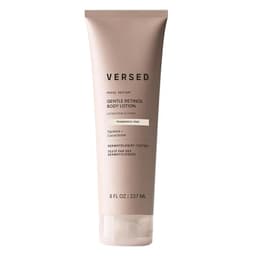
Versed Press Restart Retinol Body Lotion
The opposite product on disclosure. Versed publishes its complete 25-item ingredient list — retinol tenth, squalane eighth, and no fragrance material anywhere in it — so its fragrance-free claim rests on a published formula rather than on silence. Smaller and more expensive per ounce. Buy this one if you shave or react, and accept that you are buying less lotion for more money in exchange for knowing what is in it.
Read the full review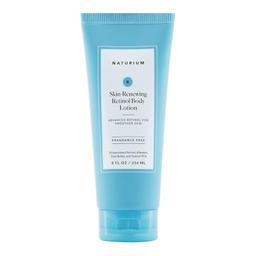
Naturium Skin-Renewing Retinol Body Lotion
The richer base and the body retinol with the most placements on this site. A shea-butter lotion that reads as a treatment rather than a daily moisturizer, at a mid-shelf price. Naturium does not publish the full list either, so it shares this product's core limitation — but the formula behind the retinol is more substantial.
$25.99 · View on AmazonRead the full reviewPrice as of November 21, 2026. #ad How we’re funded
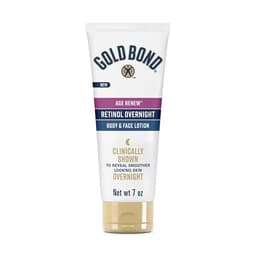
Gold Bond Age Renew Retinol Overnight Body & Face Lotion
The one body retinol here that its own brand clears for face as well as body, with a published 45-item list, niacinamide seventh and a named peptide. Dual-purpose formulas are dosed for the more delicate use, so read it as gentler rather than stronger. The pick if you want one bottle for everything and want to be able to read the formula.
$11.97 · View on AmazonRead the full reviewPrice as of November 21, 2026. #ad How we’re funded
Frequently asked questions
What percentage retinol is in Olay's retinol body lotion?
Olay does not publish one, for this product or for any product in the Retinol24 line. We checked the brand's own line page: the only figure anywhere on it is a relative claim for the MAX moisturizer — "Pro Retinol 19% more" — footnoted "vs base Retinol 24", which compares two Olay products to each other without disclosing the dose of either. The Amazon listing title names Vitamin B3 and states no retinol figure. Any site quoting you a percentage for this lotion invented it.
Is Olay retinol body lotion fragrance-free?
Not on any evidence we can find. The listing title claims "Free of Parabens & Phthalates" and says nothing about fragrance, and Olay publishes no ingredient list for this product on its own site, so there is nothing to read. We record its fragrance status as "Not published" rather than guessing in either direction. If fragrance is a concern for you — and it is among the commonest causes of allergic contact dermatitis, with a reaction that can surface hours or days later — buy the Versed lotion, where the complete published list contains no fragrance material.
Can you use it on your face?
Olay does not claim facial use for this product, and it sells a separate Retinol24 face range, so we would keep it below the jawline. This is not a safety warning so much as a dosing one: a body lotion is formulated and dosed for body skin and for a surface area many times larger than a face, and Olay points your face at different products in the same line. If you want one bottle for both, the Gold Bond lotion is the one whose brand actually clears it for face and body.
Does Olay retinol body lotion work on stretch marks or crepey skin?
Partly, and not in the way the category implies. The published record for a cosmetic retinol on body skin is real but modest — a retinol applied to aged arm skin produced measurable improvement, and tretinoin on forearms likewise — so a retinoid is the right class of ingredient for thin, crepey texture on arms and legs. What it will not do is tighten loose skin: the AAD states plainly that a cream cannot penetrate deeply enough to lift sagging skin. Established stretch marks are scar tissue, and no topical resolves them. Our crepey-skin page is the honest version of what to expect.
How long does a bottle last?
Longer than you think, and that is the main argument for it. Seventeen fluid ounces is roughly 500 ml, against the 8 oz that is standard in this category. Using fingertip-unit figures as a guide — an arm and forearm take about 3.3 units, a leg and thigh 5.8, the front of the trunk 6.7, against 2.5 for the whole face and neck — covering arms and legs a few nights a week gets through product fast. A bottle that lasts is a bottle you apply properly instead of rationing.
Is it a treatment or a moisturizer?
A moisturizer with a retinol benefit, and judging it that way is what makes it a good purchase instead of a disappointing one. The listing leads on 24-hour moisture and a lightweight, fast-absorbing finish; the retinol is one named ingredient among the claims rather than the headline. If you want a body retinoid that reads as a treatment, the Naturium or Versed lotions are formulated closer to that. If you want your existing daily body lotion to also contain a retinoid, this is the cheapest honest way to do it.
Sources
- Olay Hand & Body Lotion, Smoothing with Retinol24 — Amazon listing (Creators API record) — The listing record for ASIN B0D7WSF4MT, re-pulled through the Amazon Creators API on October 31, 2026: title "Olay Hand & Body Lotion for Women, Smoothing with Retinol24, 17 fl oz | 24HR Moisture | Lightweight & Fast-Absorbing Repair, with Vitamin B3 for Soft, Smooth Skin | Free of Parabens & Phthalates", availability "In Stock", live price returned. Cited as the ONLY spec source for this product that names its actives, because Olay publishes no ingredient list for it on its own site. Note what the title claims and does not: Vitamin B3 and 17 fl oz yes, parabens and phthalates excluded, and NO retinol percentage and NO fragrance-free claim anywhere in it (accessed October 31, 2026)
- Olay — Retinol24 collection page — Olay's own Retinol24 line page, fetched October 31, 2026. It names the active as "Pro-Retinol" and lists "Pro-retinol, triple collagen peptide, carnosine" as key ingredients, with the only descriptive line being "Pro Retinol visibly corrects wrinkles and smooths textures" — no definition of the blend and no mention of retinyl propionate. It publishes NO retinol concentration for any product in the line; the single figure on the page is a RELATIVE claim for the MAX product, "Pro Retinol 19% more* to visibly repair deep wrinkles", footnoted "vs base Retinol 24". Cited for two things only: that Olay quantifies one of its products against another while publishing no dose for either, and that the line pairs its retinol blend with niacinamide / Vitamin B3 (accessed October 31, 2026)
- U.S. FDA — 21 CFR 701.3, Designation of ingredients (eCFR) — The federal rule governing how a cosmetic ingredient list is ordered. Paragraph (a): 'The label on each package of a cosmetic shall bear a declaration of the name of each ingredient in descending order of predominance, except that fragrance or flavor may be listed as fragrance or flavor.' Paragraph (f) allows an alternative: ingredients 'present at a concentration greater than 1 percent, in descending order of predominance', followed by ingredients 'present at a concentration of not more than 1 percent, without respect to order of predominance', followed by color additives 'without respect to order of predominance'. Cited for the exact limit of what an ingredient's POSITION can tell a reader: late placement indicates the 1-percent-or-less group, but within that group the order carries no information about quantity (accessed September 26, 2026)
- Mechanistic Basis and Clinical Evidence for Nicotinamide (Niacinamide) in Skin (PMC) — Review of niacinamide's barrier, ceramide and pigmentation effects (accessed July 17, 2026)
- Long CC, Finlay AY — The finger-tip unit: a new practical measure (Clin Exp Dermatol, 1991) — The paper that defined the fingertip unit. Thirty adult patients treated various body regions; the number of FTUs required was face and neck 2.5, front of trunk 6.7, back of trunk 6.8, arm and forearm 3.3, hand 1.2, leg and thigh 5.8, foot 1.8. One FTU covers 286 cm2 (s.d. 80) — 312 cm2 in males, 257 cm2 in females. It is a dermatological DOSING measure for ointments, not a retinol instruction, and is cited here only as the published way to reason about how much topical product an area takes (accessed September 18, 2026)
- Kafi R, Kwak HS, Schumacher WE, et al. — Improvement of naturally aged skin with vitamin A (retinol) (Arch Dermatol, 2007) — Randomized, double-blind, vehicle-controlled left-versus-right ARM study in 36 elderly subjects (mean age 87): 0.4% retinol lotion or vehicle applied by study staff up to 3 times a week for 24 weeks. Fine wrinkling scores improved significantly on the retinol arm (-1.64 versus -0.08 on vehicle; p < .001), with increased glycosaminoglycan expression and procollagen I staining on biopsy. The cosmetic-retinol trial closest to hand skin: it is the arm rather than the hand, a stated 0.4%, and three applications a week (accessed September 12, 2026)
- Sumita JM, Miot HA, Soares JLM, et al. — Tretinoin (0.05% cream vs. 5% peel) for photoaging and field cancerization of the forearms: randomized, evaluator-blinded, clinical trial (J Eur Acad Dermatol Venereol, 2018) — Randomized, intrasubject, evaluator-blinded trial in 24 women over 60 (48 forearms, Fitzpatrick II-III): one forearm treated with 0.05% tretinoin cream three nights a week, the other with a 5% tretinoin peel every 2 weeks. The mean photoaging score fell 20% and the mean actinic keratosis count fell 60%, with no difference between regimens; the cream was superior on ultrasound measures of aging and both were well tolerated. The authors describe topical tretinoin cream as the gold-standard treatment for photoaging. Prescription strength, applied to the forearm — the nearest published evidence to the back of the hand (accessed September 12, 2026)
- American Academy of Dermatology — Retinoid or retinol? — AAD on the difference between prescription retinoids and OTC retinol (accessed July 17, 2026)
- Griffiths CE et al. — Restoration of collagen formation in photodamaged human skin by tretinoin (N Engl J Med, 1993) — Biopsies from 26 subjects plus 29 patients treated 10 to 12 months with daily 0.1% tretinoin cream (15 patients) or vehicle (14). Collagen I formation was 56% LOWER in photodamaged skin than in sun-protected buttock skin (P < 0.001); tretinoin produced an 80% INCREASE in collagen I formation against a 14% decrease on vehicle (P = 0.006). Prescription tretinoin, not cosmetic retinol — cited for the direction of the effect on dermal collagen (accessed September 18, 2026)
- Moisturizers — StatPearls (NCBI Bookshelf) — Reference on humectants (hyaluronic acid), occlusives and emollients (accessed July 17, 2026)
- American Academy of Dermatology — How can I find eczema friendly products? — AAD sets out the difference between the labels: unscented means a fragrance is masked so you cannot smell it, fragrance-free means the product contains no fragrance at all (accessed August 19, 2026)
- American Academy of Dermatology — Eczema types: Contact dermatitis causes — AAD names fragrance among the most common causes of allergic contact dermatitis, and notes the rash can take hours or days to appear (accessed August 19, 2026)
- Temova Rakuša Ž, Škufca P, Kristl A, Roškar R — Retinoid stability and degradation kinetics in commercial cosmetic products (J Cosmet Dermatol, 2021) — Validated HPLC-UV study of 16 retinoid derivatives (retinol, retinyl palmitate, beta-carotene and hydroxypinacolone retinoate) in 12 commercial cosmetics over 6 months of long-term and accelerated stability testing plus a one-week photostability study. Retinoid degradation followed first-order kinetics; the products showed a 0%-80% decline after 6 months at 25 °C and a 40%-100% decline at 40 °C; 'light degradation was more pronounced than temperature-induced degradation'; instabilities were 'formulation-dependent and associated with lower contents than declared in some cosmetics'. Cited for the size of the stability problem a sealed single-dose format is built to solve — the study did not test this product (accessed September 19, 2026)
- American Academy of Dermatology — Many ways to firm sagging skin — The AAD's own consumer page on skin tightening, and the clearest published statement of what a topical can and cannot do about laxity. On creams: 'If you're looking for facelift-like results from a jar, you'll likely be disappointed', 'Despite the claims, the results you see from a skin-firming cream will be subtle at best', and a cream or lotion 'cannot penetrate the skin deeply enough' to lift sagging skin — while 'A good moisturizer can plump up your skin, making fine lines and wrinkles less noticeable. This result is temporary.' On retinoids specifically: 'You may see a small change if a product contains a retinoid, such as retinol, which can help your body make more collagen.' It then lists the procedures that do tighten, with the AAD's own timelines: ultrasound, 'With 1 treatment, most people see modest lifting and tightening within 2 to 6 months'; non-invasive radiofrequency, best results 'in about 6 months' and 'Results can last 2 to 3 years'; laser treatment, '3 to 5 treatments' with results 'between 2 and 6 months'; minimally invasive radiofrequency, 'gradual tightening and lifting for close to 1 year'; laser resurfacing, the 'Most effective procedure for tightening loose skin'; and 'A surgical lift, such as a facelift or eyelid surgery, will give you the most dramatic results.' On candidacy it advises being at a healthy weight, eating a healthy diet, quitting smoking, drinking little alcohol, protecting skin from the sun and never tanning indoors, and having 'a small amount of sagging skin' — adding 'Do you have lots of sagging skin? If so, skin-tightening may not be helpful.' Cited for the published limit on topicals and for what the real treatments for laxity are (accessed October 3, 2026)
- American Academy of Dermatology — What can make my hands look younger? — AAD states that for wrinkly, crepe-paper-like skin on the hands a dermatologist may recommend a lotion containing a retinol or glycolic acid, applied before bedtime, often alongside a light chemical peel every 1 to 3 months; that many adults develop age spots on their hands which grow with age and time in the sun, and that skin-lightening creams and lotions take the longest to deliver results but cost less than cryosurgery, laser, peels or microdermabrasion; that rough scaly patches on the hands may be actinic keratoses (precancerous growths that usually develop in fair-skinned people aged 40 or older) and should be checked by a dermatologist; that loss of fullness makes hand skin lax and crepe-paper-like and is treated with fillers, not topicals; and, for maintaining results, to apply a broad-spectrum water-resistant SPF 30+ sunscreen to the hands every day before going outdoors, wear gloves while cleaning and gardening because hot water, detergents and yard work dry and age the hands, and moisturize after washing (accessed September 12, 2026)
- American Academy of Dermatology — 4 skin care tips for your hands — AAD (quoting board-certified dermatologist Diane S. Berson, MD, FAAD) states that the hands are exposed to the elements more than other parts of the body; that once the barrier is compromised from frequent wetting and not moisturizing enough, irritants, allergens and infectious particles are more likely to penetrate, and severely dry skin can develop deep cracks and infections; that antimicrobial cleansers can be more drying and alcohol sanitizing gels strip the skin's natural oils, so a moisturizer should be applied after every wash or sanitizer use; to choose a fragrance-free, dye-free hand cream or ointment containing lipids (ceramides), humectants (glycerin, hyaluronic acid) and occlusives (mineral oil, petrolatum), from a tube rather than a pump bottle; that unprotected sun exposure on the hands produces age spots (lentigines), roughness, wrinkling and dryness, and that hands are prone to actinic keratoses; to apply a broad-spectrum, water-resistant SPF 30+ sunscreen to the hands daily year-round; and, at night, to apply a cream or ointment and then put on cotton gloves (accessed September 12, 2026)
- Rafal ES, Griffiths CE, Ditre CM, et al. — Topical tretinoin (retinoic acid) treatment for liver spots associated with photodamage (N Engl J Med, 1992) — 10-month randomized, double-blind, vehicle-controlled trial in 58 patients applying 0.1% tretinoin (n = 28) or vehicle (n = 30) cream daily to the face, the upper extremities, or both. Significant lightening of hyperpigmented lesions versus vehicle after one month (p < 0.002); after 10 months 83% (20 of 24) of tretinoin-treated patients with facial lesions had lightening versus 29% (8 of 28) on vehicle, and the results for lesions of the upper extremities were similar. Biopsies showed decreased epidermal pigmentation, correlated with clinical lightening. In a 6-month follow-up, lesions that had disappeared did not return in any patient, and 6 of 7 who continued tretinoin improved further. Prescription tretinoin, not cosmetic retinol (accessed September 12, 2026)
- Fleischer AB Jr, Schwartzel EH, Colby SI, Altman DJ — The combination of 2% 4-hydroxyanisole (mequinol) and 0.01% tretinoin is effective in improving the appearance of solar lentigines and related hyperpigmented lesions in two double-blind multicenter clinical studies (J Am Acad Dermatol, 2000) — Two phase III randomized, controlled, double-blind trials in which subjects applied a 2% mequinol / 0.01% tretinoin solution, either active alone, or vehicle twice daily to all solar lentigines and related hyperpigmented lesions on the face, forearms and BACKS OF HANDS for up to 24 weeks. The combination was clinically superior to each component and to vehicle on the forearms and face (p <= .03, except versus tretinoin alone on the face in trial 2). Most skin-related adverse events were mild. A prescription combination that is no longer widely sold — cited here because it is the trial that explicitly treated the backs of the hands, not as a product recommendation (accessed September 12, 2026)
- American Academy of Dermatology — How to apply sunscreen — AAD on how much sunscreen to use (about a teaspoon for the face) and reapplying every two hours (accessed August 11, 2026)
Keep reading
Best retinol body lotion
The full category ranked, with the disclosure differences between the brands laid out side by side.
See the picksVersed retinol body lotion, reviewed
The same category with the opposite disclosure: a complete published formula and a fragrance-free claim you can check.
Read the reviewRetinol for crepey skin
The concern this product is most often bought for, and the line between thin skin and real laxity.
See what worksRetinol for stretch marks
What a retinoid can and cannot do to a mark that has already turned silver.
Read moreOlay Retinol 24, reviewed
The face product from the same line, and the same disclosure problem at a higher price point.
Read the reviewBest retinol for your 40s
Where a body retinol starts mattering, and why the neck and arms are usually further behind than the face.
See the picks