Retinol Room.

Retinol and Eczema

Retinol is not an eczema treatment, and on skin that is actively flaring it will make things worse. But eczema-prone is not the same as eczema now — here is when atopic skin can carry a retinoid, where it must never go, and how to introduce one without provoking anything.

By Stephen V.Last updated How we pick

How this is funded: we earn a commission if you buy through our links, at no extra cost to you. It never changes which product we recommend, and we’ll tell you when we’d skip one. Full disclosure.

The short answer

Retinol does nothing for eczema, and on skin that is actively flaring it will make things worse. Atopic dermatitis is an inflammatory condition with a barrier defect at its core; a retinoid works by accelerating turnover, which stresses that barrier further. Putting one on an active flare is working directly against the thing you are trying to fix.

But “eczema-prone” and “eczema right now” are not the same state, and a great many people with well-controlled atopic dermatitis want the anti-ageing benefits a retinoid offers. For them the answer is not a flat no — it is a carefully hedged yes, on facial skin only, at the lowest strength available, away from the areas where eczema actually appears.

One thing worth saying up front: the AAD’s own self-care page for atopic dermatitis does not mention retinol, retinoids or anti-aging products at all. There is no official guidance here to follow, which means this is a judgement call, and a dermatologist who can see your skin is better placed to make it than any website.

Why the two are in tension

Atopic dermatitis is characterized by a compromised skin barrier. Water leaves faster than it should, irritants get in more easily than they should, and the result is the itch-scratch-inflammation cycle that defines the condition. That is why the AAD’s treatment guidance leads with moisturizer for everyone who has it, on the basis that “keeping your skin well moisturized helps to prevent cracks and fissures in your skin that could lead to a worsening rash, itching, or infection”.

A retinoid does the opposite thing to the same layer, at least at first. Turnover accelerates, the stratum corneum is briefly less competent than it was, and water loss rises. On normal skin that is the tolerable adjustment period everyone talks about. On skin whose barrier is already the problem, it is a push in a direction that is already going wrong.

There is also a diagnostic problem. Irritant contact dermatitis from a retinoid and an eczema flare look broadly similar and feel broadly similar. If you start a retinoid and your face goes red and itchy, you will not reliably be able to tell which happened — which is the practical argument for introducing one so slowly that the answer is never in doubt.

When it is reasonable to try

All of the following, not some of them:

  • Your eczema is well controlled and has been for weeks. Not “mostly fine”. Settled.
  • The area you want to treat is the face, and your face is clear. Facial atopic dermatitis is common; if yours involves the face, this is a conversation with a dermatologist rather than a decision to make from a product page.
  • You are already moisturizing properly. The AAD’s self-care guidance is a thick fragrance-free cream or ointment at least twice a day, warm rather than hot water, baths limited to five or ten minutes, and a mild fragrance-free cleanser used only when needed. If that routine is not already in place, put it in place first.
  • You have told whoever manages your eczema that you are doing this. Particularly if you are on a prescription topical, where the interaction question is theirs to answer.
  • You are willing to stop. This is the one people fail. A flare means stop, not persevere.

How to introduce it, if you are going to

  1. Patch test properly first. The AAD’s advice for testing a new product on atopic skin is a quarter-sized amount on the inner arm, daily, for seven to ten days — not one application and a glance the next morning. Allergic reactions in particular can take days to appear.
  2. One night a week. For a month. Not two. The standard beginner ramp is already too fast here.
  3. Face only, and not the whole face. Cheeks and forehead. Keep it away from around the eyes, the nasolabial folds if they crack, and the neck.
  4. Sandwich it, always. Moisturizer, then the retinoid, then moisturizer again. On atopic skin this is not an optional technique for the difficult weeks — it is how the product gets used at all. Our sandwich method guide covers it.
  5. Change nothing else for two months. No new cleanser, no acids, no vitamin C, no new moisturizer. You are running an experiment with one variable.
  6. Stop at the first sign of a flare. Not when it gets bad. At the first sign. Our retinol burn guide covers the repair protocol.

The routine this has to sit on top of

For atopic skin the moisturizer is not the supporting act, it is the treatment the AAD recommends for everyone with the condition. These are the two this site already prescribes for the buffering and the cracked patches — the plain fragrance-free cream that does the sandwiching, and the ointment for anywhere that has split.
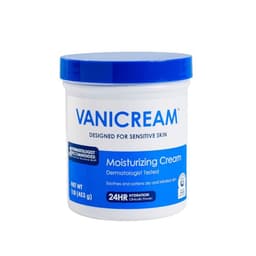
Vanicream Moisturizing Cream, 16 oz tub

The sandwich layer

Vanicream Moisturizing Cream, 16 oz tub

The dull, no-actives cream the sandwich method asks for — the listing's own pitch is that it is formulated without common irritants, which is the whole specification here. The tub size is the point: buffering only works if you are generous with it.
$13.19 · View on Amazon

$14.7711% off

Price as of September 19, 2026. #ad How we’re funded

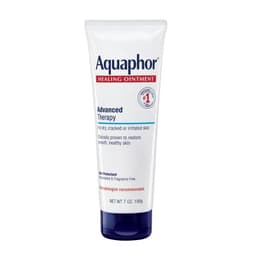
Aquaphor Advanced Therapy Healing Ointment, 7 oz

For the flaky patches

Aquaphor Advanced Therapy Healing Ointment, 7 oz

A skin protectant ointment for the places a retinoid peels first — the creases beside the nose, the corners of the mouth, the patch where you used too much. It seals rather than treats, which is exactly what an over-worked barrier needs, and it is the wrong thing to put under a retinol layer.

$12.97 · View on Amazon

Price as of September 19, 2026. #ad How we’re funded

None of these are retinols — they are the supporting products this page already recommends, listed so you can act on the advice. Product images supplied by Amazon; prices are live and dated on each button.

What to look for in a product

  • Fragrance-free, and check which word is on the label. The AAD distinguishes the two: “unscented” means a fragrance has been masked so you cannot smell it, while “fragrance-free” means none was added. Fragrance is among the most common causes of allergic contact dermatitis, and this is the single most important filter on this page.
  • A low stated strength. A published 0.1% or 0.2% lets you start at a dose you can actually reason about. An unpublished strength on atopic skin is an unnecessary unknown.
  • Barrier ingredients in the base. Ceramides, niacinamide, panthenol. A formula supporting the barrier while the active stresses it is doing the thing that matters most here.
  • A short ingredient list. Fewer components means fewer candidates when something goes wrong, and atopic skin reacts to a wider range of things than most.
  • A gentle retinoid form. Published tolerance work puts retinol and retinaldehyde in a low-irritation band relative to retinoic acid, and encapsulated formulations are designed for slower release. Neither makes a product suitable for eczema — they just widen the margin.

The formulas that make this survivable

If you have decided to try, the formula matters more here than anywhere else on this site. Three non-negotiables: fragrance-free, barrier ingredients in the base, and a low strength you can actually see on the label. These three are the picks from our registry that come closest on all three counts. None of them is an eczema treatment and none of them will prevent a flare — they are simply the least provocative way into the category. Prices are live and dated on each button.

#1Best ceramide-buffered option

CeraVe Resurfacing Retinol Serum

Encapsulated retinol with ceramides and licorice root, aimed squarely at post-acne marks and texture rather than deep wrinkles. Gentle, barrier-friendly and cheap — but the strength is unstated, so set expectations by what it's for.

Strengths

  • Ceramides + niacinamide support the barrier while the retinol works
  • Encapsulated delivery is gentler on reactive skin
  • One of the least expensive 'real' retinol serums

Trade-offs

  • Concentration is not published
  • Marketed for marks, not deep wrinkles — set expectations accordingly
Key activeEncapsulated retinol
Stated concentrationNot published
FormatFluid lotion-serum
Fragrance-freeYes
Best forAcne-prone, Normal, Sensitive

Formulation note. Encapsulated retinol + 3 essential ceramides + niacinamide + licorice root extract. The ceramide payload is why it stays tolerable; the retinol strength is not disclosed.

Ingredients and claims read from the product listing, on July 18, 2026. “Not published” means the brand does not state that figure.

#2Gentlest encapsulated formula

Versed Press Restart Gentle Encapsulated Retinol Serum

One of the few products that puts the delivery system in the product name rather than burying it: encapsulated retinol, with bakuchiol alongside, in a light face serum at a genuinely low price. A sensible gentle route in, provided you accept an unstated dose.

Strengths

  • Encapsulation is stated on the listing, not implied by marketing adjectives
  • Bakuchiol alongside the retinol for a softer on-ramp
  • Light texture and a low price for a face serum

Trade-offs

  • Retinol percentage is not published
  • Bakuchiol's evidence base is far thinner than retinol's — treat it as tolerability, not potency
Key activeEncapsulated retinol + bakuchiol
Stated concentrationNot published
FormatLight serum
Fragrance-freeNot published
Best forSensitive, Beginner, Normal

Formulation note. Encapsulated retinol paired with bakuchiol, per the listing. Encapsulation holds the retinol in a carrier that releases it more gradually, which tends to lower irritation for a given amount of active. The amount itself is not stated.

Ingredients and claims read from the product listing, on August 11, 2026. “Not published” means the brand does not state that figure.

#3Lowest stated strength

The Ordinary Retinol 0.2% in Squalane

The gentlest true-retinol starting point on the shelf: a stated 0.2% in the same cushioning squalane base. If you have never used a retinoid, this is where to begin before touching anything stronger.

Strengths

  • Stated 0.2% — a genuine beginner strength, plainly labeled
  • Squalane base softens the early dryness
  • About as cheap as effective retinol gets

Trade-offs

  • Too gentle to be anyone's long-term destination — you'll want to step up
  • Still pure retinol, so introduce it slowly regardless of the low number
Key activeRetinol
Stated concentration0.2%
FormatLightweight oil serum
Fragrance-freeYes
Best forSensitive, Beginner, Normal

Formulation note. 0.2% pure retinol in squalane — the entry rung of The Ordinary's three-strength ladder. Starting here and moving to 0.5% only once nightly use is comfortable is the textbook way to build tolerance.

Ingredients and claims read from the product listing, on July 18, 2026. “Not published” means the brand does not state that figure.

Where a retinoid must not go on atopic skin

  • Anywhere that is currently flaring. Broken, weeping, cracked or actively inflamed skin absorbs differently and is already inflamed. Treat the flare first, with whatever your clinician has given you for it.
  • The eyelids, if you get eyelid eczema. This is a common presentation, the skin is the thinnest on the body, and it is the area most likely to react to anything at all.
  • Flexural sites — inner elbows, behind the knees, the neck. These are where atopic dermatitis characteristically lives, they are occluded by their own anatomy, and there is no cosmetic reason to put a retinoid there.
  • Hands, if you have hand eczema. Hand skin is already barrier-compromised by washing. Our hands page covers retinoid use there for people who do not have eczema; with it, the answer is a dermatologist’s.
  • Anywhere at all, during a widespread flare. Pause entirely and restart when things have been settled for weeks.

What actually treats eczema

Worth being explicit, because this is a retinol site and the honest answer is that retinol has nothing to offer here. The AAD is clear that atopic dermatitis “cannot be cured, but proper treatment can control it”, that dermatologists recommend a moisturizer for everyone who has it, and that the prescription topicals used on it are corticosteroids, tacrolimus and pimecrolimus, crisaborole, roflumilast, ruxolitinib and tapinarof — plus a growing list of systemic options for severe disease.

No retinoid appears on that list. If eczema is your primary problem, the answer is a dermatologist and the products above, not a serum from a roundup.

The honest summary

Retinol does nothing for eczema, can provoke it, and should never go on skin that is currently flaring. Eczema-prone skin in remission can often carry a low-strength, fragrance-free, well-buffered retinoid on the face if it is introduced slowly and kept away from the flexures and the eyelids — but it is an elective cosmetic decision on skin with a lower margin than most, and a professional who can see your skin is better placed to make it than a website.

General guidance, not medical advice. Retinol Room is written by an enthusiast, not a dermatologist. For a diagnosis, a reaction, or a prescription active like tretinoin, see a qualified professional. Introduce any new active slowly and patch-test first.

Frequently asked questions

Can you use retinol if you have eczema?

Not on skin that is currently flaring, and not on the flexural sites where atopic dermatitis characteristically appears. On facial skin that has been settled for weeks, many eczema-prone people tolerate a low-strength, fragrance-free, well-buffered retinoid introduced very slowly — but it is an elective decision on skin with a smaller margin than most, and it is worth running past a dermatologist first.

Does retinol help eczema?

No. It is not an eczema treatment and it appears nowhere in the AAD's list of what atopic dermatitis is treated with — which runs through moisturizer, topical corticosteroids, calcineurin inhibitors, crisaborole, roflumilast, ruxolitinib and tapinarof, plus systemic options for severe disease. A retinoid works on turnover and collagen, not on the inflammation eczema involves.

Can retinol cause eczema?

It can cause irritant contact dermatitis, which looks and feels similar and is sometimes mistaken for eczema appearing. It can also trigger a flare in someone who already has atopic dermatitis by disrupting an already-fragile barrier. Whether that counts as causing eczema is a definitional question; practically, the answer is that it can produce eczema-like skin on people prone to it.

What retinol is best for eczema-prone skin?

The gentlest one you can find that still states a strength: fragrance-free, low labeled percentage, and a base carrying ceramides or niacinamide. No product is formulated for eczema-prone skin with a retinoid in it, and any brand claiming otherwise is making a marketing claim rather than a regulated one.

Can I use retinol between eczema flares?

That is the only window in which it is reasonable to consider it. Wait until skin has been completely settled for several weeks, start at one night a week on the face only, buffer on both sides with moisturizer, and stop at the first sign of a flare rather than pushing through.

Is fragrance-free important with eczema?

More than almost anything else. The AAD's eczema guidance is built on fragrance-free products throughout, and it also distinguishes the labels: "unscented" means a fragrance is present but masked, while "fragrance-free" means none was added. Those are different claims and only one of them is useful here.

What should I use instead of retinol if I have eczema?

For the eczema itself, whatever your clinician prescribes plus a thick fragrance-free moisturizer applied at least twice a day. For the anti-aging goal a retinoid would have served, bakuchiol and niacinamide are the two most reasonable alternatives — our retinol alternatives page covers what the evidence supports for each.

Can I use retinol on my face if my eczema is on my body?

Usually yes, provided the face has been clear and settled. Atopic skin tends to be more reactive everywhere, so the slow introduction still applies, but eczema confined to the flexures does not rule out a careful facial routine. Stop if the face starts behaving like the affected areas.

Sources

Keep reading